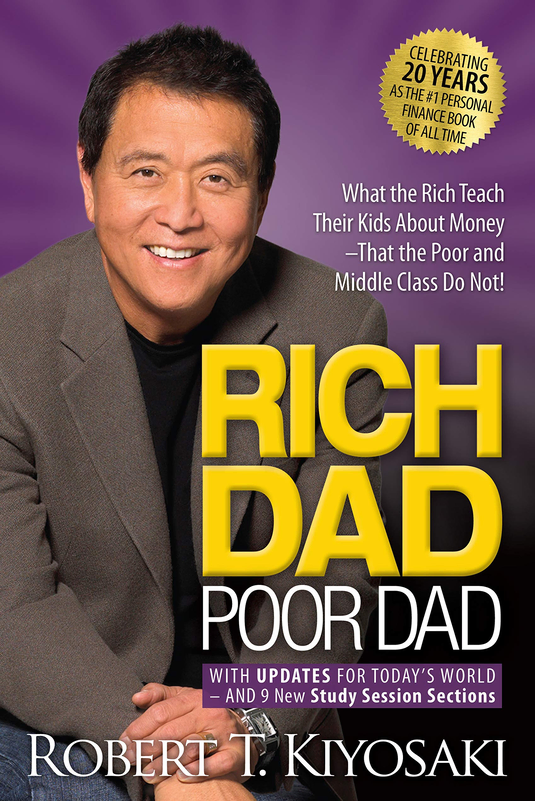
Author: Robert T. Kiyosaki
Read Time: ~6 Hours
Moneygatha Rating: ⭐⭐⭐⭐⭐ (4.8/5)
The Lesson: The Rich Don’t Work for Money
The Verdict: This is not just a book; it is a wake-up call. It challenges the “go to school, get a job” mindset that keeps the middle class poor. While Babylon teaches you how to save, this book teaches you how to think. If you want to stop working for money and make money work for you, this is the starting line.
Loved this review? Explore the full Moneygatha book library to master your mindset, strategy, and discipline.
The Brutal Truth
We are raised with a script: “Beta, study hard, get good grades, find a safe government job (or MNC), and save money.”
Robert Kiyosaki calls this “The Trap.”
Most people spend their entire lives working for money. They get a salary, pay bills, get a raise, buy a bigger car, and pay bigger bills. They run faster and faster just to stay in the same spot. This is the Rat Race.
“Rich Dad Poor Dad” is a slap in the face to the traditional education system. It exposes a harsh reality: Schools teach you how to work for money, but they never teach you how to make money work for you.
If The Richest Man in Babylon is the Math, and Psychology of Money is the Therapy, then Rich Dad Poor Dad is the Wake-Up Call.
3 Lessons That Will Change Your Mindset
Most people forget what they read in a week. But these three concepts are the backbone of the book. If you understand these, you understand wealth.
1. The Rich Don’t Work for Money
This is the most famous quote from the book. The poor and middle class work for money. They have a job, they get a salary, and they pay bills. Fear keeps them in this trap. Fear of not paying bills, fear of being fired, fear of starting over. Kiyosaki calls this the “Rat Race.” The rich are different. They don’t trade their time for money. They make their money work for them.
The Moneygatha Takeaway: Stop asking “How can I get a raise?” Start asking “How can I make money while I sleep?”
2. Know the Difference: Assets vs. Liabilities
This is where 99% of educated people fail. They think their house is an Asset. Kiyosaki says it is a Liability.
Here is the simplest definition of money you will ever read:
- An Asset puts money IN your pocket (e.g., Rental property, Stocks, a Business).
- A Liability takes money OUT of your pocket (e.g., Car loan, House EMI, Credit Card debt).
To visualize the difference in mindset, look at this comparison:
| Feature | Poor Dad (Old Mindset) | Rich Dad (New Mindset) |
| Philosophy | “Study hard so you can find a good company to work for.” | “Study hard so you can find a good company to buy.” |
| Money | Works for money (Salary). | Money works for him (Investments). |
| Risk | “I can’t afford it.” | “How can I afford it?” |
| House | “My house is my biggest asset.” | “My house is a liability.” |
| Reaction | Avoids risk to feel safe. | Manages risk to get rich. |
3. Mind Your Own Business
Your “Profession” is what you do for someone else (e.g., Accountant, Engineer). Your “Business” is what your assets do for you. Most people spend their lives minding someone else’s business (making their boss rich) and making the government rich (taxes). You don’t need to quit your job today. But you must start building a column of assets—stocks, bonds, or a side hustle—that grows without you. This is the secret to Passive Income.
Top 3 Quotes
“Winners are not afraid of losing. But losers are. Failure is part of the process of success. People who avoid failure also avoid success.
“The single most powerful asset we all have is our mind. If it is trained well, it can create enormous wealth in what seems like an instant.”
“It’s not how much money you make. It’s how much money you keep.”
Who Should Read This?
✅ Read this if:
- You are an employee who feels stuck in the “Rat Race.”
- You want to teach your children about money before the world does.
- You are scared of taking financial risks.
❌ Skip this if:
- You are looking for a step-by-step guide on “Which stocks to buy” (This is a mindset book, not a manual).
- You get easily offended by someone criticizing the traditional school system.
Frequently Asked Questions
Is Rich Dad Poor Dad a true story? It is debated. Robert Kiyosaki says the “Rich Dad” was his best friend’s father, but many believe the character is a metaphor for the lessons he learned. However, whether the person existed or not, the lessons are 100% real and effective.
Is this book good for Indian readers? Yes. Although it talks about American real estate, the core concept (Assets vs. Liabilities) applies perfectly to India. In fact, Indian middle-class families often suffer the most from the “good grades, safe job” mentality that Kiyosaki criticizes.
What should I read after this? Once you have the mindset from this book, read The Psychology of Money to learn how to behave with your wealth.
Related Moneygatha Reads
Many of the ideas in this book show up repeatedly in real life.
Final Verdict
This is not a book. It is a red pill.
It will make you angry at the school system. It will make you question your career choices. And that is exactly why you must read it.
If you want to stop working for money and start making money work for you, this is Day 1.