
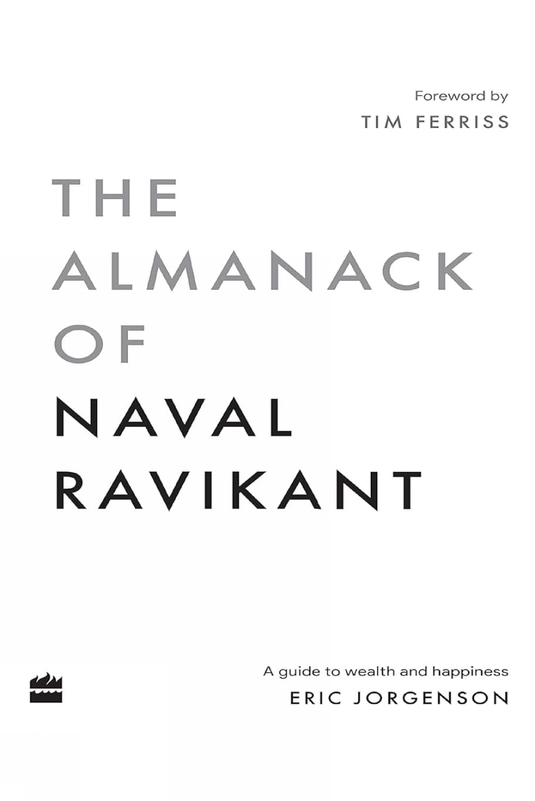
Author: Eric Jorgenson
Read Time: ~4 Hours
Moneygatha Rating: ⭐⭐⭐⭐⭐ (5/5)
The Lesson: Wealth is a skill you learn, not a lottery ticket you win. You get rich by owning equity, not by renting your time.
The Verdict: Stop selling your time. This book destroys the idea that “hard work” equals wealth. Naval proves that you need specific knowledge and leverage (code, media, capital) to get rich while you sleep. If you want to escape the 9-to-5, this is your map.
The Brutal Truth
Welcome to our Almanack of Naval Ravikant review.
In India, we are raised on one big lie: “Khoob mehnat karo, safalta milegi” (Work hard, and you will succeed). Our parents tell us to study hard, get a safe job in an MNC or Government, and grind for 40 years.
But here is the reality check: If hard work was the secret to wealth, the construction worker carrying bricks in the hot sun would be the richest man in the city. The Rikshawala would be a billionaire. They work harder than any CEO. So why are they poor?
The Almanack of Naval Ravikant answers this. Naval (who shares our Indian roots) argues that hard work is overrated. You don’t get rich by renting out your time. You get rich by owning things (Equity) and using Leverage (Code, Media, Money).
“This book is not about how to save a few rupees. It is about how to build a business that makes money while you sleep. If you are stuck in the ‘9-to-5 loop,’ this book is your exit strategy.”
3 Lessons That Will Change Your Wealth
Naval Ravikant is not teaching you how to work; he is teaching you how to win. Here are the three pillars of wealth creation from the book.
1. Stop Renting Your Time (Equity)
You will never get rich renting out your time. If you are paid a salary, you are renting your time. The problem is that your time is limited. You can’t work 24 hours a day.
To get rich, you need to disconnect your inputs (hours worked) from your outputs (money earned).
The Moneygatha Takeaway: You must own equity—a piece of a business, a stock, or a product—to gain financial freedom. If you don’t own a piece of a business, you don’t have a path to financial freedom.
2. Specific Knowledge (Play vs. Work)
Specific knowledge is knowledge that you cannot be trained for. If society can train you, it can replace you.
- Specific Knowledge feels like play to you, but looks like work to others.
- It is found by pursuing your genuine curiosity, not by chasing what is “hot” right now.
When you are doing what you love, you can work for 16 hours without getting tired, while your competition gets tired after 4 hours. That is how you win.
3. The 3 Types of Leverage
To make money while you sleep, you need leverage.
- Labor: Hiring people to work for you. (Hard to manage).
- Capital: Using money to make money. (Requires you to be rich first).
- Code & Media: The new leverage. Writing software or creating content (blogs/YouTube) that works for you 24/7.
The Moneygatha Takeaway: Code and Media are the “Permissionless Leverage.” You don’t need anyone’s permission to write a blog or code an app. It works for you while you sleep.
The Moneygatha Experiment: Did It Work?
I didn’t just read this book; I used it to change my career.
For years, I was trapped in the “Freelancer Mindset.” I thought I was a business owner, but I was just a glorified employee. If I didn’t work today, I didn’t get paid. I was selling my hours, and there is a limit to how many hours I can sell. I felt like a hamster on a wheel.
After reading The Almanack of Naval Ravikant, I realized I was missing Leverage. Naval says: “Code and media are permissionless leverage. They are the leverage behind the newly rich.”
I couldn’t code, so I chose Media.
The Result: I started this blog (Moneygatha). Writing this review took me 4 hours. But once I hit publish, this article works for me 24/7. It will be read by thousands of people while I am sleeping, eating, or traveling. This is the difference between Working (selling time) and Building (creating assets).
The Brutal Truth: It is scary to work for free in the beginning (building the asset). But it is the only way to eventually get paid while you sleep.
Top 3 Quotes
“Earn with your mind, not your time.”
“Seek wealth, not money or status. Wealth is having assets that earn while you sleep. Money is how we transfer time and wealth. Status is your place in the social hierarchy.”
“Play long-term games with long-term people. All returns in life, whether in wealth, relationships, or knowledge, come from compound interest.”
Who Should Read This?
✅ Read this if:
- You are tired of your 9-to-5 job and feel like you are just “renting” your life away.
- You want to understand how the internet has changed the rules of making money.
- You want to build a solo business (Content Creator, Coder, Consultant).
❌ Skip this if:
- You just want a “safe” job and a steady paycheck for the rest of your life.
- You think rich people are evil and money is bad.
- You want a step-by-step technical guide (This book is about strategy, not tactics).
Frequently Asked Questions
Did Naval Ravikant write this book? No. Naval is famous for not writing books (he prefers tweets and podcasts). This book was curated and compiled by Eric Jorgenson, with Naval’s approval. It collects his best wisdom from the last decade into one organized manual.
Is this book only for tech people? No. While Naval talks about “code,” the principles apply to everyone. “Code” is just a metaphor for leverage. If you are a writer, your “code” is your book. If you are a teacher, your “code” is your online course. It is about scalability, not programming.
Can I get this book for free? Yes. Naval believes knowledge should be free. You can download the PDF for free at Navalmanack.com. However, we recommend buying the physical copy because you will want to highlight and bookmark almost every page.
Final Verdict
This is the most dense book on wealth ever written.
Most business books could be a blog post. This book is the opposite—every sentence packs a punch. It doesn’t give you a checklist; it gives you a new operating system for your brain.
It teaches you that Wealth + Happiness is possible. You don’t have to be miserable to be rich, and you don’t have to be poor to be happy.
Related Posts on Moneygatha
If you want to explore these ideas further, these posts expand on the themes discussed here:
Loved this review? Explore the full Moneygatha book library to master your mindset, strategy, and discipline.