
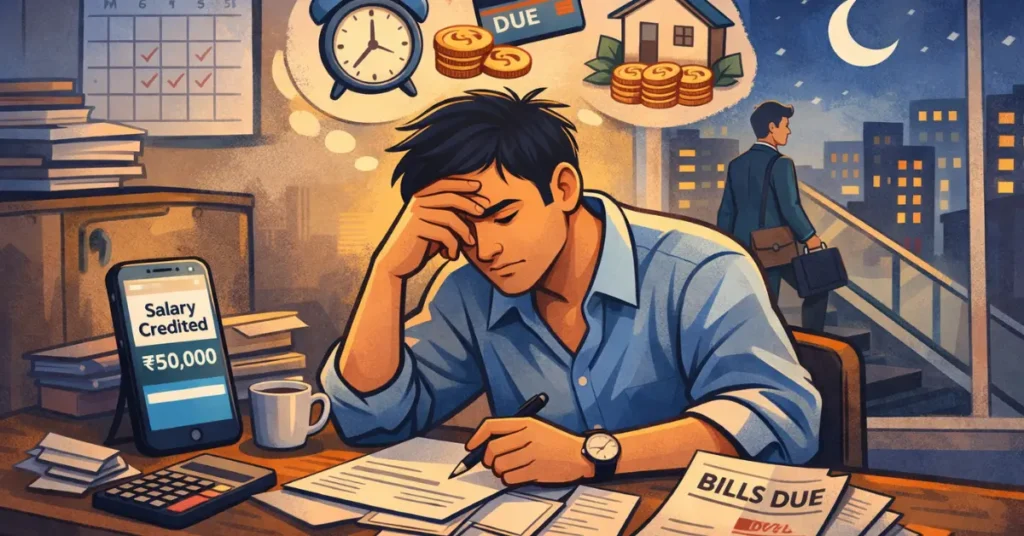
The salary message comes around 9:12 a.m.
₹38,400 credited.
This is where most people assume they’re moving forward.
You open the banking app. The number sits for a second. Then the quiet math begins.
Around ₹12,000 will go to EMI in a few days. It always does.
You close the app. A second later, you open GPay.
The screen fills with small payments.
₹149.
₹220.
₹89.
₹340.
Coffee.
Auto.
Food delivery.
Another coffee.
Nothing dramatic.
Just small things scattered across the week.
Around lunchtime, a colleague walks into the office holding a new iPhone box. People gather around his desk. Someone asks the price.
You glance at the GPay screen again.
The list keeps going.
₹60.
₹180.
₹120.
Tiny amounts.
But somehow they look heavier today.
Contents
Why the Month Always End With Little or No Savings
It rarely happens in one big mistake.
It happens in small, predictable cycles.
The salary arrives. For a brief moment, the account looks full.
Rent leaves first. It always does.
Fuel gets filled every few days. Small amount, repeated across the month.
The bike or car just keeps moving, and so does the money.
Then come the normal transfers. A little money sent home. Something parents need. Something small for the house.
Nothing unusual. Just responsibilities that feel routine.
By the middle of the month, the bank balance already looks different. Not empty. Just thinner.
After that, spending becomes careful.
Food orders are checked twice. Small purchases are delayed. The GPay history slowly fills with tiny payments again.
₹80.
₹150.
₹240.
Nothing stands out on the statement. No luxury purchases. No reckless spending.
Just an ordinary month.
And near the end, saving becomes a small calculation.
If anything remains, it moves to savings.
Most months, nothing does.
How Salary Slowly Turns Into a Maintenance System
At first, the salary looks like progress.
Every year it increases a little. The number grows. It looks like things are moving forward.
But after a few years, something strange becomes visible.
The pressure never really disappears.
Rent increases when the salary increases.
Family responsibilities grow slowly.
Fuel costs more than it used to.
Daily life quietly expands to fill the new income.
Nothing looks extravagant. Life just becomes slightly more expensive.
For a while, it feels temporary. Like things will settle once the salary grows enough.
But the “enough” point never really arrives.
A new expense appears.
A new responsibility shows up.
Something else needs attention.
The salary keeps working hard to hold everything in place.
Bills get paid.
Rent is handled.
Parents are supported.
Life stays stable.
And stability starts to look like success.
Years pass like this.
But slowly a quiet realization forms.
Nothing is actually moving. It’s just being maintained.
The salary was never really creating freedom.
It was mostly keeping life from falling apart.
The Hidden Structure That Controls Your Money
After a while, the pattern starts to feel strangely organized.
Income arrives once a month. Almost everything else follows the same rhythm.
Rent has a date.
EMIs have a date.
Credit card bills have a date.
Subscriptions renew automatically.
Money arrives in a single block, then slowly breaks apart into smaller commitments.
Most of these commitments are fixed. They don’t adjust to how the month actually goes.
The salary arrives, but a large part of it is already scheduled to leave.
This structure quietly shapes how money behaves.
The salary arrives once a month.
Almost every financial commitment is built around the same schedule.
Money comes in.
Money gets distributed.
Nothing really stays.
Nothing in this structure is dramatic. It feels normal because almost everyone around us follows the same pattern.
But after watching the cycle repeat for years, a small question begins to appear.
Maybe the struggle isn’t only about how people manage money.
Maybe it’s also about how the entire financial system is arranged.
Why Most People Feel Stuck Even After Years of Work
After enough years, the pattern becomes familiar.
Not obvious. Just familiar.
Most people sense it long before they understand it.
The salary comes.
The month fills with obligations.
Life stays stable, but nothing really separates from the cycle.
Friends around you live the same way. Colleagues talk about increments, bonuses, and rising costs. Conversations about money often sound similar.
Everyone is working.
Everyone is earning.
And yet very few people feel financially ahead.
It doesn’t feel like failure. Life is functioning. Bills are paid. Responsibilities are handled.
From the outside, it looks like progress.
But somewhere underneath, a quiet confusion remains.
Years of effort should feel like movement.
Instead, it often feels like maintenance.
What makes this pattern harder to notice is how normal it appears. When millions of people follow the same financial rhythm, it stops looking unusual.
It becomes the default shape of adult life.
— I remember reading this in Rich Dad Poor Dad, and it stayed with me – how people can spend years working without ever stepping out of the cycle.
Which raises a strange question most people rarely pause to ask.
If the pattern is so common, why do our decisions around money keep repeating it?
And once you start seeing this pattern, another question becomes difficult to ignore → Why Even Smart People Stay Financially Stuck for Decades.