
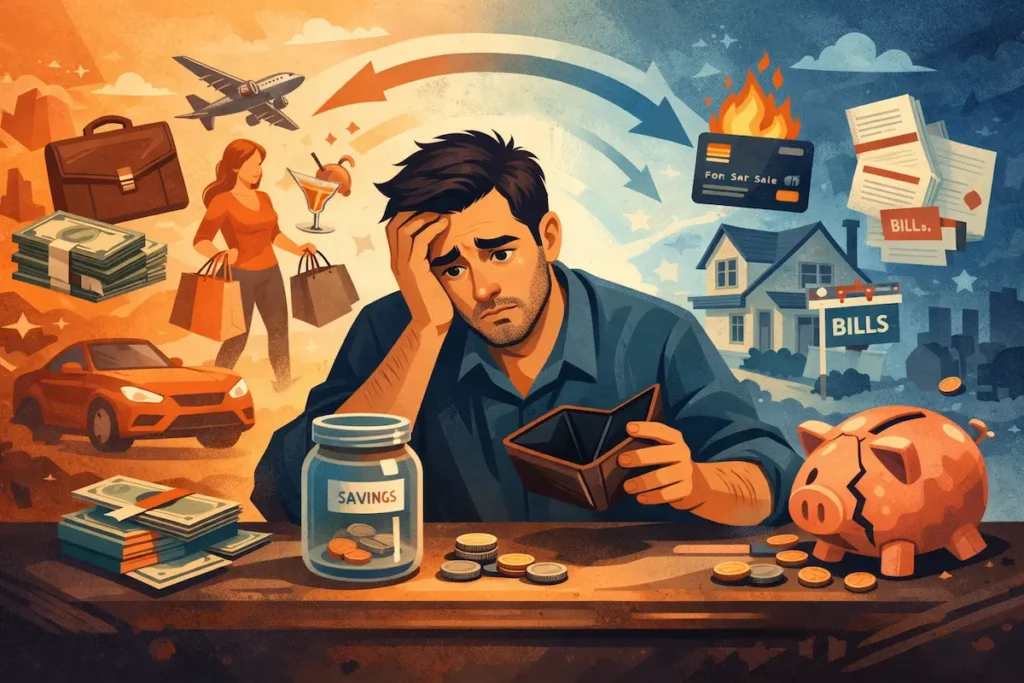
You think the problem is your salary.
That if you earned a little more, you would finally be able to save money.
But pause for a moment and look deeper.
There are people earning the same income as you.
Some of them are building savings quietly.
Others remain stuck, wondering why their salary disappears every month.
So the question is no longer about how much you earn.
Why can’t you save money despite a good salary?
The answer is not loud. It does not argue with you.
It simply runs quietly in the background — like a program you never installed but cannot uninstall.
As income increases, life expands with it.
Your needs feel bigger. Your standards rise.
What once felt like enough slowly becomes insufficient.
And without realizing it,
you are not moving ahead.
You are simply maintaining a more expensive version of the same life.
This is the pattern most people never see.
And because they do not see it, they cannot escape it.
Contents
The Floor Keeps Rising
My colleague earns 15,000 a month.
His watch broke recently. Not a luxury watch. Just the one he wore every day.
The first thing he said was,
“I cannot feel comfortable without it.”
Not “I will replace it later.”
Not “let me check my budget.”
Just discomfort. Immediate. Real.
That feeling is the pattern.
Six months ago, he did not own that watch.
He woke up, went to work, lived his life without it.
There was no discomfort then. No sense of something missing.
Then he bought it.
It became normal.
And the moment it broke, normal felt broken too.
This is how lifestyle inflation works.
It does not ask for permission.
It enters quietly, raises the standard of what feels acceptable,
and then turns it into something you cannot live without.
What was once a want becomes a need.
What was once a need becomes a non negotiable.
Your salary keeps increasing.
But your expectations rise with it, just a little ahead each time.
And that is why you still cannot save money.
This is not about the watch.
The watch is simply where the pattern becomes visible.
The Habits You Stop Questioning
My colleague smokes every day.
I do not know when it started.
But I know he no longer thinks about it.
Morning chai.
A cigarette.
Then the day begins.
That is the nature of habits.
They stop feeling like choices.
One cigarette a day becomes thirty in a month.
Multiply that across a year, and it is no longer a small number.
But it never feels like a problem.
Because it never appears all at once.
This is how comfort spending works.
Not one big decision.
But a hundred small ones that no longer feel like decisions at all.
The daily coffee.
The quick recharge.
The snack you pick up without thinking.
Individually, it feels harmless.
Together, it is quietly eating your salary every month.
And that is why you cannot save money.
At this point, someone will say,
what is the point of saving?
We are here to enjoy life.
What if tomorrow never comes?
It is a fair question.
But look closely.
Is he smoking because it brings real enjoyment?
Or because the day feels incomplete without it?
Is that freedom, or is that dependency?
Real enjoyment is conscious.
Lifestyle inflation is unconscious.
In one, you decide to spend.
In the other, your habits decide for you.
And most people never pause long enough to see the difference.
You cannot change what you do not notice.
And these patterns survive by remaining invisible.
EMI: Borrowing From a Future That Was Supposed to Save
Your salary arrives.
And before you can do anything with it, it’s already distributed.
Rent.
EMI.
Subscriptions.
Gone.
This is what most people don’t realize.
They think they are spending this month’s salary.
They are actually clearing last month’s decisions.
My colleague bought his phone on EMI.
Not because he couldn’t wait.
Because it felt manageable.
Small amount every month.
That’s how EMI is sold to you.
Not as debt.
As comfort.
Now let’s be honest.
Not every EMI is wrong.
I bought my scooty on EMI because that’s how I get to work.
That’s a tool, not a lifestyle decision.
The question is simple.
Does this purchase generate value or just comfort?
One is an investment.
The other is lifestyle creep with monthly installments.
Stack two or three comfort EMIs and your salary has prior commitments before you even touch it.
The month starts and the money is already spoken for.
You are not broke. You are pre-spent.
And if you have ever wondered why you earn every month but still feel broke, this pattern is only one part of the answer.
And a pre-spent person cannot save.
Not because they earn less.
Because the money has already been promised to the past.
The “After This” Illusion
After the trip, he will start saving.
After the EMI clears.
After things settle down.
After this one last expense.
You have heard this before.
Maybe you have said it yourself.
The problem is that “after this” never actually arrives.
Because life doesn’t pause.
The moment one thing settles, something else appears.
Another expense.
Another reason.
Another month gone.
Saving was never supposed to start after something.
It was supposed to start now.
But “now” always feels like the wrong time.
This is not laziness.
This is how the mind protects comfort.
Starting tomorrow feels like the same thing as starting today.
But tomorrow has been coming for months now.
My colleague has a trip planned.
The intention is real.
But intention without a system
is just a feeling that expires at the end of the month.
People don’t fail to save because they don’t want to.
They fail because they are waiting for the right moment.
And the right moment is designed to always be just one month away.
The Pattern You Cannot Unsee
This is not four different problems.
It is one pattern showing up in four different places.
The floor rising.
The habits running on autopilot.
The salary pre-spent before it arrives.
The savings always starting next month.
All of it is the same thing.
Life expanding silently to consume whatever you earn.
And the most dangerous part is not the spending.
It is that none of it feels wrong in the moment.
The watch feels necessary.
The cigarette feels normal.
The EMI feels manageable.
The trip feels like the last thing before everything changes.
It all makes sense individually.
That is why nobody catches it.
You are not making bad decisions.
You are making unconscious ones.
And unconscious decisions made consistently
will always produce the same result,
no matter how much your salary grows.
Now you see the pattern.
And once you see it,
you cannot unsee it.
Arkad figured this out in ancient Babylon.
The problem was never income. It was always the system — or the lack of one.
That idea stayed with me while reading The Richest Man in Babylon.
And if you have ever wondered why the money leaves so fast the moment it arrives — that is a different pattern worth understanding. → Why You Impulse Buy After Salary Day Every Time.