
Every month, you work hard. You get paid.
And within weeks, that money is gone — rent, EMIs, credit card bills, things that felt necessary in the moment.
You didn’t spend carelessly.
You spent the way everyone around you spends.
Same timing, same triggers, same empty account — a spending loop that starts the moment your salary hits.
That’s exactly the problem.
This is what opportunity cost actually looks like in real life.
Not a textbook concept — just the slow, invisible death of your future freedom, one “reasonable” purchase at a time.
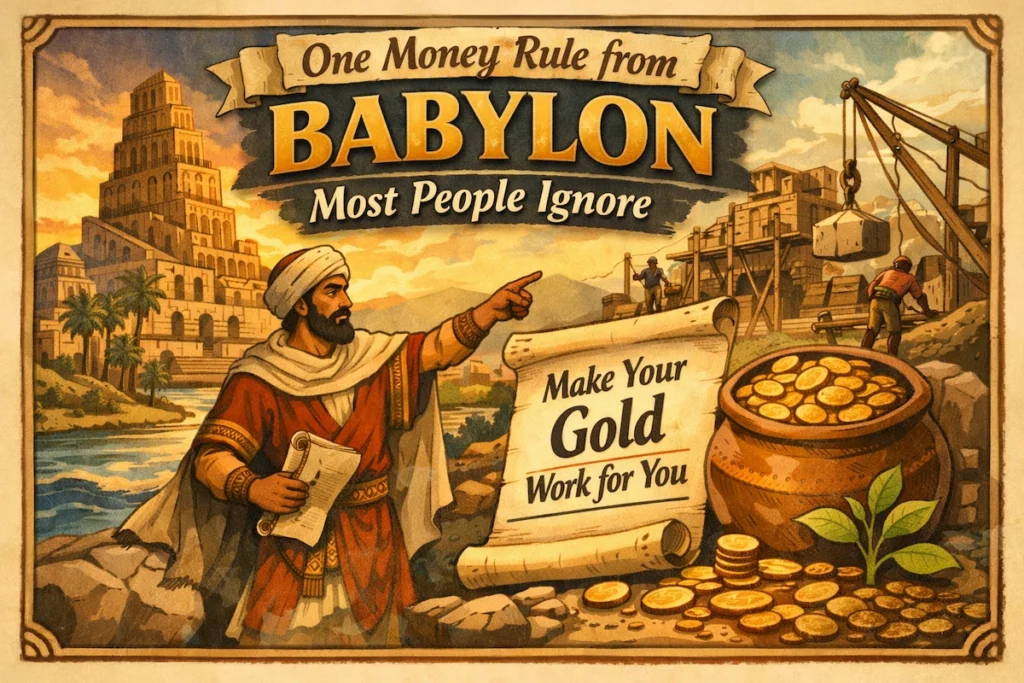
The ancient rule is simple: pay yourself first.
Ten percent, before anything else.
Not what’s left at the end of the month — because nothing is ever left at the end of the month.
Most people flip this without realizing it.
They pay the landlord first. The bank first. The brand first.
And then themselves — never.
Here’s what that actually does: the time value of money starts working against you.
Every unit of money you delay investing is a unit that could have been compounding for your future.
Instead, it’s compounding for someone else’s.
Babylon didn’t have stock markets or index funds.
But it understood one thing clearly — if you don’t keep a part of what you earn, you are not building wealth.
You are just a very busy middleman.
Contents
The Math of the Modern Slave: Why Your Salary Disappears Every Month
Thirty days of work. Early mornings, deadlines, exhaustion.
And on the 31st day — zero balance.
Not because you were reckless.
Because this is exactly how the system is designed to work.
Your salary doesn’t belong to you yet.
It enters your account and immediately leaves — rent, loan EMI, credit card bills, even that subscription you forgot existed.
You are not the destination.
You are just the route.
Here is what nobody says directly:
You are working full-time to keep Apple, Nike, and Starbucks profitable.
Every upgrade. Every logo. Every overpriced coffee —
paid for with your hours.
Voluntarily.
Every single month.
This is where most people misread money.
When you buy a $500 phone, you are not spending $500.
You are spending 80 to 120 hours of your life — the time it took to earn that amount.
The phone loses value the moment you open the box.
Those hours are gone permanently.
This is the real cost of living paycheck to paycheck.
Not just a money problem —
a time problem.
And time, unlike money,
cannot be earned back.
The Richest Man in Babylon named this centuries ago:
A man who spends everything he earns will always remain poor, regardless of how much he earns.
The number on your paycheck is almost irrelevant.
What you keep is everything.
And before you say, “but I genuinely need a phone” —
nobody is arguing against that.
Need is real.
The question is never what you buy.
It is the sequence in which you buy it.
Are you buying it after gutting this month’s savings?
Or after paying yourself first — ten percent aside, non-negotiable — and then spending the rest however you choose?
Buy the phone.
Just don’t let the phone
buy your future.
The Babylon Protocol: The 1/10 Rule That Builds Real Wealth
Thousands of years ago, a wealthy man in ancient Babylon shared one of the simplest — and most ignored — financial rules ever created.
Keep one-tenth of everything you earn.
Before rent. Before bills. Before anything else.
The first payment of every month belongs to you.
That’s it. No complex strategy. No financial degree required.
But here’s what most people misunderstand:
This ten percent is not savings.
Savings is what survives at the end of the month.
This is different.
This is a decision you make before the month even begins.
You are not saving what’s left.
You are spending what’s left after saving.
Think of every $100 you earn as 10 seeds and 90 fruits.
The fruit, you can spend — on rent, food, life.
But the seeds? The seeds go into the ground. Every single time. No negotiation.
That becomes your Freedom Fund.
Not an emergency fund.
Not a “just in case” account.
A fund with one job: to grow — quietly and consistently — until it starts working harder than you do.
This is what the ancient rule really means:
Pay yourself first.
Not second. Not last. First.
“But I Can Barely Cover My Expenses…”
This is the most common pushback — and it deserves an honest answer.
If you genuinely cannot save ten percent, start with one percent.
The amount matters less than the habit.
But before you conclude that your income is the problem, ask yourself one question:
Have you ever tracked exactly where your money goes for 30 days?
Most people haven’t.
And most people are surprised when they do.
The Richest Man in Babylon puts it bluntly:
If you cannot save one-tenth of what you earn,
your problem is not your income — it’s your relationship with money.
A higher salary will not fix a mindset that treats every dollar earned as a dollar to be spent.
History is full of high earners who still ended up broke.
The one-tenth rule is not about the number.
It’s about making a clear decision — once and for all —
that your future is worth funding.
Asset Velocity vs. Liability Drag: Why Saving Alone Won’t Make You Wealthy
Saving ten percent is the first move.
But saving alone is not the destination.
Money sitting idle in a bank account is like stagnant water.
It doesn’t grow. Inflation slowly eats it away.
You may feel secure,
but your purchasing power is quietly shrinking every year.
This is where asset velocity comes in.
It’s the speed at which your money generates more money.
A saved dollar has zero velocity.
An invested dollar — in an index fund, a business, or real estate — has velocity.
It moves.
It compounds.
It works while you sleep.
The wealthy understand one distinction most people never learn:
Assets put money in your pocket.
Liabilities take money out.
A car bought on loan is a liability — it costs you every month.
A skill that earns freelance income is an asset.
Your Freedom Fund, once invested, becomes an asset too.
Wealthy people spend their lives accumulating assets.
Everyone else spends their lives accumulating the appearance of wealth —
gadgets, cars, brands — liabilities dressed up as success.
Your ten percent is the seed.
Asset velocity is what happens when you plant it
instead of leaving it sitting in a jar.
Designing Your Wealth Architecture: 3 Steps to Make the Ancient Rule Work
Knowing the rule is not enough.
Most people know it. Most people still don’t follow it.
The gap between knowing and doing is where wealth dies.
Here’s how you close that gap:
Step 1: Automate the Ten Percent
Humans are weak at the point of decision.
When your salary arrives and bills are waiting,
that ten percent will always feel negotiable.
So remove the decision entirely.
Set up an automatic transfer — the moment your income hits, ten percent moves out.
Not tomorrow. Not after you check your balance. Immediately.
You cannot spend what you never see.
Systems beat willpower every single time.
Step 2: Eliminate Validation Spending
Look at your last 30 days of spending.
Identify every purchase made to:
- impress someone
- signal status
- feel temporarily better
That is validation spending — and it’s one of the biggest leaks in most financial lives.
You are spending real money, real hours of your life,
to perform wealth for people who are not thinking about you.
Stop funding that performance.
Spend on what genuinely improves your life.
Cut everything that is just noise.
Step 3: Respect the Time Horizon
Your Freedom Fund needs 3 to 5 years of uninterrupted compounding before it shows meaningful results.
This is where most people fail.
They plant the seed…
and dig it up six months later for a vacation or an upgrade.
Leave it alone.
Compounding is not dramatic in year one.
It becomes powerful in year five.
And transformative in year seven.
Patience is not a side skill.
It is the strategy.
Understanding the rule is one thing.
But if you are still stuck in the cycle of working for money and wondering how to actually flip that — this is where to go next.