
You don’t lose money in the market first.
You lose control of your decisions.
Every investor believes they’ll stay rational—until volatility hits.
Prices rise, and you feel urgency. Prices fall, and you feel fear.
That fear isn’t random—it’s deeply tied to how we perceive uncertainty in markets, something most investors only recognize after understanding why volatility itself feels so uncomfortable.
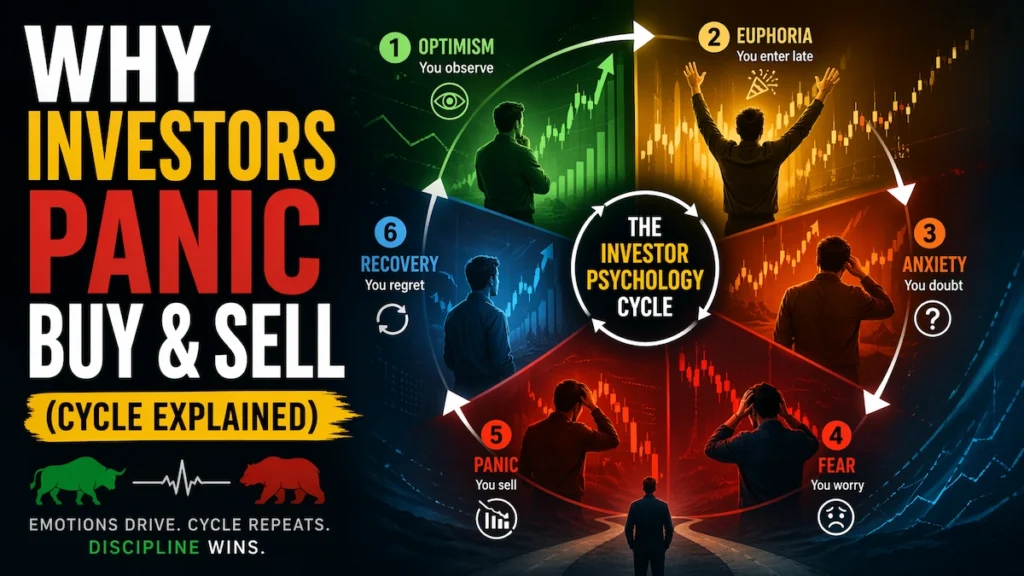
Investors panic buy and sell because fear and greed override logical decisions during market volatility,
leading to buying high and selling low.
This isn’t bad luck.
It’s a predictable behavioral loop.
In this guide, you’ll understand why investors panic buy and sell, how the investor psychology cycle works, and how to break it.
Table of Contents
Why Investors Buy High and Sell Low (Emotional Investing Mistakes Explained)
Let’s make this simple.
- Rising market → feels safe → you buy
- Falling market → feels unsafe → you sell
This is emotional investing.
You act when confidence is high and exit when fear is high.
Which means your timing is always… late.
This is why most investors struggle—not because they lack knowledge, but because they react to price instead of value.
Investor Psychology Cycle: Why Investors Panic Buy and Sell
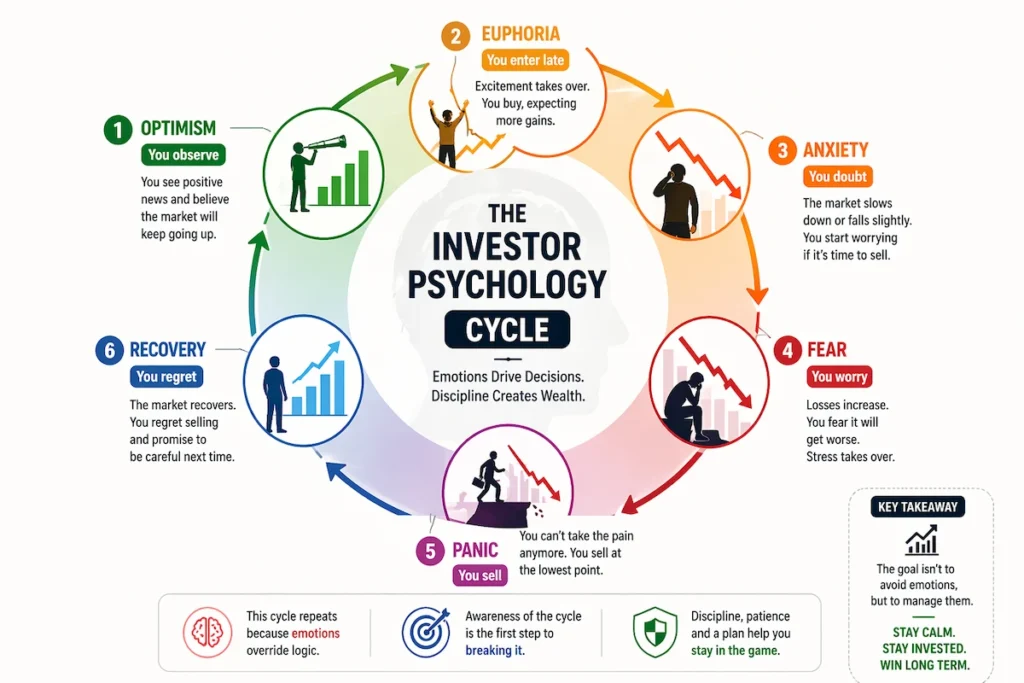
This cycle appears in every market—stocks, crypto, real estate.
Because markets move…
but human behavior repeats.
Phase 1: Optimism
You notice the market rising.
No urgency yet.
Phase 2: Euphoria
Momentum builds.
- Others are making money
- Success stories are everywhere
- You feel pressure to act
You enter late.
Phase 3: Anxiety
The trend slows.
You check your portfolio more often.
Doubt begins.
Phase 4: Fear
Prices fall further.
Now the same market that felt safe starts feeling risky.
Phase 5: Panic
Losses accelerate.
You don’t want more damage.
So you sell.
Phase 6: Capitulation
You’re out.
Relief comes—but so does regret later.
Phase 7: Recovery
Markets recover.
You hesitate… then re-enter late.
And the cycle repeats.
Quick Reality Check
If you’ve ever:
- Bought after a strong rally
- Sold after a sudden drop
- Checked your portfolio multiple times a day
You’re not unlucky.
You’re following a pattern most investors don’t even realize they’re in.
Investor Panic Cycle (Quick Summary)
- Optimism → You observe
- Euphoria → You enter late
- Anxiety → You doubt
- Fear → You worry
- Panic → You sell
- Recovery → You regret
This cycle repeats because emotions peak at the wrong time.
Where Are You in This Cycle Right Now?
If you’re reading this, you’re not outside the cycle.
You’re somewhere inside it.
- Feeling excited and thinking of entering? → You’re in Euphoria
- Feeling uneasy but still holding? → You’re in Anxiety
- Thinking of selling to “protect”? → You’re in Fear or Panic
- Already exited and waiting? → You’re in Capitulation
The mistake is not being in the cycle.
The mistake is not recognizing your position in it.
Behavioral Finance: Why Your Brain Causes Panic Selling
This isn’t about intelligence.
It’s about wiring.
Loss Aversion
Losses feel about twice as painful as gains feel good.
That’s why even small drops feel urgent.
This behavior is explained in Prospect Theory by Daniel Kahneman.
Herd Mentality
When others buy, you feel safe buying.
When others sell, you feel safe selling.
But the crowd is usually late at both extremes.
Recency Bias
You assume what’s happening now will continue.
This leads to poor timing.
Confirmation Bias
You look for information that supports your emotions.
And ignore what doesn’t.
Real Examples of Panic Cycles in Markets
This isn’t new. It’s a repeating pattern.
Dot-com Bubble (2000)
During the Dot-com Bubble:
- Investors chased hype
- Prices surged
- Then collapsed
Panic followed.
2008 Financial Crisis
During the 2008 Financial Crisis:
- Fear dominated markets
- Investors exited near the bottom
But recovery came—and those who stayed benefited.
COVID-19 Crash (2020)
During the COVID-19 Market Crash:
- Markets dropped rapidly
- Panic peaked
Then recovery came faster than expected.
Stock Market Panic Selling: What Data Proves
Emotions feel right.
But data tells a different story.
For example, an investor who stayed invested in the S&P 500 for 20 years saw strong long-term returns—but missing just the 10 best days reduced returns by more than 50%.
This is where most people get trapped—reacting to short-term volatility instead of understanding what it really represents.
Why Even Smart Investors Panic During Market Volatility
This isn’t about intelligence.
Even experienced investors struggle.
Because when markets fall, your brain treats it like danger.
It pushes you to act immediately.
But investing rewards the opposite:
patience.
Truth vs Lie — The Biggest Investing Illusion
| Lie | Truth |
|---|---|
| “I’ll sell before it crashes” | You sell after it crashes |
| “I’ll buy when it’s safe” | You buy when it’s expensive |
| “This time is different” | It follows the same pattern |
How to Control Emotions in Investing (Avoid Panic Buying and Selling)
You don’t eliminate emotion.
You design around it.
When you feel the urge to act immediately:
- Pause for 24 hours
- Do NOT check price repeatedly
- Revisit your original investment reason
- Ask: “Has the business changed, or just the price?”
If only price changed, your decision should not.
Panic-Proof Investing Framework
Rule 1: Pre-Commit Your Strategy
Before investing, decide:
- Your holding period
- When you will NOT sell
This removes decision-making during stress.
Rule 2: Invest Gradually
Instead of investing everything at once:
- Enter in phases
- Add more during dips
This reduces pressure.
Rule 3: Define Your Panic Line
Example:
“If markets fall 20%, I will not sell.”
Decide this before fear appears.
Rule 4: Focus on Value, Not Noise
Great investors don’t chase price—they focus on value.
That’s the core idea behind The Intelligent Investor, where discipline matters more than prediction.
Rule 5: Build Protection Into Your Strategy
The smartest investors don’t just think about returns—they think about downside.
They create a buffer before they need it.
(That’s why concepts like margin of safety exist—they aren’t about fear, they’re about preparation.)
The Real Truth — The Market Is Not the Problem
Markets move.
That’s normal.
But panic?
That comes from interpretation.
Two investors see the same crash:
- One sees danger
- One sees opportunity
The difference is not knowledge.
It’s control.
Final Insight — Awareness Is Your Only Edge
Most investors think they need better strategies.
But without awareness, strategy collapses under pressure.
Once you recognize the investor psychology cycle—
optimism, euphoria, fear, panic—
You stop reacting.
And that changes everything.
Because the real edge in investing is not predicting the market…
It’s understanding yourself inside it.
Most investors react.
A few investors observe.The moment you recognize this cycle…
you stop being the crowd.
Frequently Asked Questions
Why do investors panic buy and sell?
Because emotions like fear and greed override logic, especially during volatility.
What is panic selling in the stock market?
It’s selling investments due to fear during market drops, often locking in losses.
How can I avoid panic investing?
Use rule-based strategies, diversification, and long-term investing discipline.
What is the investor psychology cycle?
A repeating pattern of emotions influencing decisions: optimism → panic → recovery.
Why is emotional investing dangerous?
It leads to poor timing, losses, and missed long-term gains.