
Imagine reaching every financial goal you once dreamed about and still feeling behind.
This is the hidden paradox of money. The finish line keeps moving.
And until you define what “enough” means for you, wealth can become an endless race with no winner.
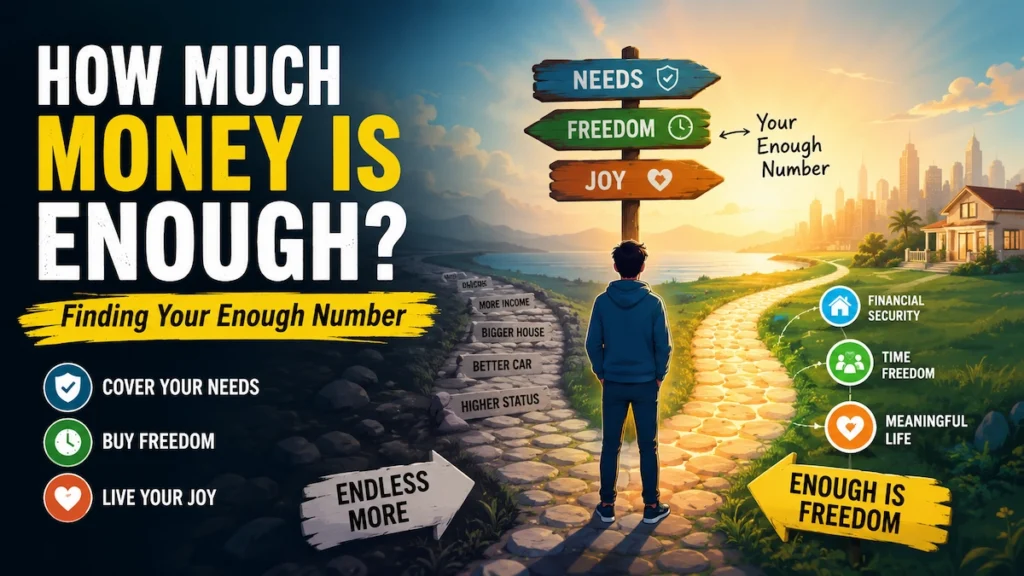
There is no universal amount of money that is “enough.” Your enough number depends on your lifestyle, essential expenses, personal values, and financial goals. The key is reaching a point where additional income adds little to your happiness, freedom, or overall life satisfaction.
For years, I assumed that earning more money would finally make me feel secure.
Every salary increase brought a rush of excitement, but it never lasted.
Within a few weeks, the higher income felt normal, and the desire for more returned.
That’s when I started asking a question I had avoided for years:
How much money is enough?
Contents
Why More Money Doesn’t Always Create More Happiness
The mind has a favorite lie.
“Just a little more.”
A little more income.
A little more success.
A little more money.
And then, finally, happiness.
But have you noticed something strange?
Every time you reach the next level, the excitement fades.
The raise that once felt life-changing becomes ordinary.
The purchase that once felt exciting becomes invisible.
The dream slowly turns into the new normal, a phenomenon known as hedonic adaptation.
This is why so many people wonder how much money is enough to be happy.
Not because they lack money.
Because they lack an ending.
Desire does not want enough.
Imagine pouring water into a bucket with no bottom.
No matter how much you add, it never feels full.
For many people, money works the same way.
The problem is not their income.
The problem is that they have never decided what “enough” looks like.
Without a definition of enough, every financial goal becomes a temporary stop on an endless journey.
This is the hidden law of wealth:
The first dollars buy survival.
The next dollars buy comfort.
The next dollars buy convenience.
But beyond a certain point, each additional dollar buys less happiness than the one before it.
This is the phenomenon economists call the diminishing returns of wealth.
The outer number keeps growing.
The inner experience stays the same.
That is why some people earn modest incomes and feel deeply satisfied, while others accumulate fortunes and still feel restless.
Often, the problem is not income but the expectations attached to it.
A person who cannot say “enough” will never experience abundance.
So before asking how to earn more, ask a deeper question.:
How much money is enough for the life I truly want?
Because happiness is not found at the end of the race.
It begins the moment you stop running blindly.
How to Know When You Have Enough Money
Most people never answer this question.
They spend decades earning, saving, investing, and upgrading their lifestyle.
Yet they never stop to ask:
How will I know when I have enough money?
Without an answer, life becomes a race with no finish line.
You keep running.
And “more” becomes a habit rather than a need.
The truth is that enough is not a number found on the internet.
It is a relationship between your money and your life.
You have enough money when your essential needs are covered.
Your future no longer feels threatened by every unexpected expense.
Your spending reflects your values, your real hourly wage, instead of your insecurities.
Additional income no longer creates meaningful improvements in your daily life.
This is where many people become confused.
They mistake desire for necessity.
They mistake status for security.
They mistake comparison for ambition.
Comparison constantly whispers that you are behind.
But comparison is a game that cannot be won.
There will always be a bigger house.
A larger portfolio.
A higher income.
A more impressive lifestyle.
If your definition of success depends on having more than someone else, then enough will never arrive.
A simple way to test your own financial satisfaction is to ask:
- Can I comfortably meet my essential expenses?
- Am I making decisions from freedom rather than fear?
- Does my money support the life I want to live?
- If my income stopped growing tomorrow, would I still feel grateful for what I already have?
These answers reveal whether your money is serving your life or quietly controlling it.
Because the moment you can say, “I have enough for the life I want,” money stops being a source of constant anxiety.
It becomes a tool.
And a tool is meant to serve you—not rule you.
Finding Your Enough Number
Most people are searching for a number.
A salary target.
A net worth milestone.
A retirement figure.
But the real challenge is not finding a bigger number.
It is finding a number that is enough.
According to concepts from behavioral psychology, happiness research, and the “Enough” philosophy popularized by Your Money or Your Life, fulfillment does not come from maximizing income. It comes from aligning your money with the life you actually want to live.
Research in positive psychology suggests that once basic financial needs are met, long-term well-being depends increasingly on factors such as purpose, relationships, autonomy, and personal growth rather than income alone.
Your enough number is the amount of money required to support that life.
Not the life your neighbors live.
Not the life social media sells.
Your life.
To find your enough number, start with three simple questions:
A Simple Enough Number Framework
You don’t need a perfect formula to begin.
A practical starting point is:
Essential Expenses + Freedom Buffer + Joy Spending = Your Enough Number
The goal is not mathematical precision.
The goal is understanding how much money is required to support a life that already feels complete.
What Does It Cost to Meet My Essential Needs?
This includes housing, food, transportation, healthcare, and other non-negotiable expenses.
These costs create your financial foundation.
What Does It Cost to Create Freedom?
Freedom expenses are the things that give you time, flexibility, and peace of mind.
Emergency savings.
Debt reduction.
Investments.
The ability to say “no” when necessary.
What Does It Cost to Create Joy?
Joy is different from status.
Status is buying something to impress others.
Joy is spending on things that genuinely make your life richer.
Travel.
Learning.
Meaningful experiences.
Time with people you love.
When you combine these three categories, you begin to see how much money you really need.
And that number is often smaller than the one your mind has been chasing.
The goal is not to build the largest possible life.
The goal is to build a life that feels complete.
Because once you know your enough number, money stops being an endless pursuit.
It becomes a conscious choice.
The Trap of Lifestyle Inflation
Lifestyle inflation is what happens when every increase in income is followed by an increase in spending.
The mind says:
“Now that I earn more, I deserve more.”
A bigger house.
A newer car.
A more expensive lifestyle.
Soon, what was once a luxury becomes a necessity.
And despite earning more, you feel no freer than before.
This is the trap.
The outer life expands, but the inner feeling remains unchanged.
The irony is that many people do not become poor because they earn too little.
They become trapped because their desires grow faster than their income.
Truth vs. Lie
| Lie | Truth |
|---|---|
| More income means more freedom | More control means more freedom |
| A bigger lifestyle creates happiness | A bigger lifestyle often creates bigger obligations |
| Wealth is having more | Wealth is needing less |
The moment you stop upgrading every part of your life, money begins to create space instead of pressure.
That space is where the feeling of enough is born.
How Much Money Is Enough for Financial Independence?
There is no universal number for financial independence.
Your enough number depends on three things:
- Your annual living expenses
- Future inflation
- The income your investments can generate
For example, if you need $50,000 per year to live comfortably today, that amount will likely be much higher in the future as inflation increases the cost of living.
This means financial independence is not about saving a fixed amount of money.
It is about building assets that can grow and generate income faster than inflation reduces your purchasing power.
A practical starting point is to calculate your current annual expenses and estimate what they may cost 10, 20, or 30 years from now.
Then ask yourself:
“How much invested capital would I need to support those expenses without relying on a paycheck?”
The answer will be different for everyone.
Someone who is content living on $50,000 a year may reach financial independence far sooner than someone who needs $150,000 a year to maintain their lifestyle.
This is the paradox most people miss.
Every new desire raises the price of freedom.
Most people believe independence comes from having more.
Often, it comes from needing less.
Because financial independence is not about owning everything.
It is about reaching the point where your money can support your life—even as inflation rises and your needs evolve.
And for most people, that point arrives long before they expect it.
To figure out your exact numbers, check out our step-by-step guide on how to use an Expense Tracking Template.
Frequently Asked Questions
Can You Ever Have Enough Money?
Yes, but only if you define what enough means for you. Without a clear definition, financial goals keep expanding and the feeling of “not enough” persists regardless of income. Enough is a personal threshold, not a universal number.
Why Do Rich People Still Want More Money?
Money often stops being about survival and becomes tied to status, comparison, or identity. As wealth grows, desires can grow with it, making satisfaction difficult to maintain even when financial needs are already met.
What Is the Difference Between Being Wealthy and Having Enough?
Wealth is a financial measure based on assets and net worth. Having enough is a personal measure based on whether your money supports the life you want. A person can be wealthy without feeling satisfied, and satisfied without being extremely wealthy.
Does Financial Independence Mean You Never Have to Work Again?
Not necessarily. Financial independence means work becomes a choice rather than a necessity. Many financially independent people continue working because they enjoy it, not because they depend on a paycheck to survive.
What Is the Biggest Mistake People Make When Defining Their Enough Number?
The biggest mistake is basing it on other people’s lifestyles. Your enough number should reflect your values, needs, and goals—not social expectations, comparison, or the desire to impress others.