
Your bank account is not a mystery.
It is a mirror.
Every expense is a footprint of your unconscious choices.
Until you track them, your money will keep leaving without saying goodbye.
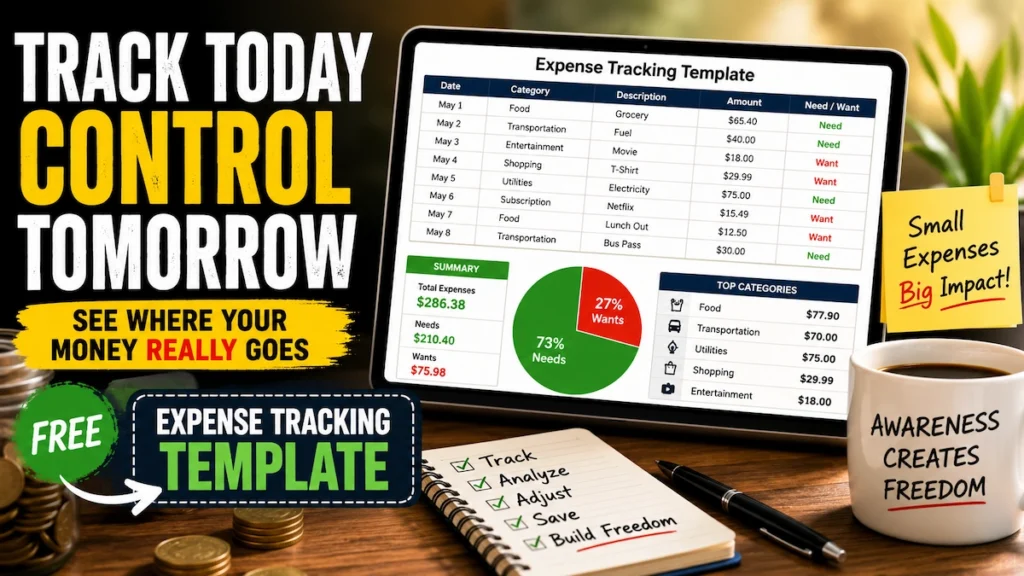
An expense tracking template is a simple tool used to record and categorize daily, weekly, or monthly expenses. It helps you understand spending patterns, identify unnecessary spending, and make better financial decisions. By consistently tracking expenses, you can create awareness around your spending habits and take the first step toward financial freedom.
When I first started tracking every expense, I thought I would find a few unnecessary purchases.
I was wrong.
Small daily expenses that felt harmless were quietly draining my income.
A snack here. A subscription there.
Nothing looked expensive on its own.
But tracking every dollar revealed spending patterns I had never noticed before.
For the first time, I could clearly see where my money was actually going.
Contents
What Is an Expense Tracking Template and Why Does It Matter?
An expense tracking template is a simple tool that helps you record, organize, and monitor your daily, weekly, or monthly expenses.
Instead of wondering where your money went at the end of the month, you can see every expense in one place.
This awareness is powerful.
Most people believe they have a money problem. In reality, they often have an awareness problem. Small purchases made on autopilot can quietly consume hundreds or even thousands of dollars each year.
A good tracking system helps you:
- Track every expense in one place
- Identify unnecessary spending
- Understand your spending habits
- Create a realistic budget
- Make better financial decisions
The goal is not to judge your spending.
Because you cannot change what you do not notice.
This is the same realization that completely changed the way I looked at money after reading Your Money or Your Life.
That is why expense tracking is often the first step toward better money management and long-term financial freedom.
Why Most People Never Know Where Their Money Goes
Money rarely disappears in a single dramatic moment.
It leaves quietly.
A coffee on the way to work. A subscription you forgot about. A purchase made out of boredom rather than need.
Individually, these expenses seem harmless.
Together, they tell a story.
The problem is that most people never see that story because they never pause long enough to look. They earn, spend, repeat—and call it normal.
A simple tracking system changes this.
It brings awareness to what was previously invisible.
Suddenly, money is no longer vanishing into a black hole. You can see where it goes, why it goes there, and whether those expenses truly add value to your life.
The truth is simple.
People do not lose control of their finances because they are bad with money.
They lose control because unconscious spending feels effortless.
Clarity changes everything.
The moment you begin tracking your expenses, you stop guessing and start seeing reality as it is.
Free Expense Tracking Template: Download and Start Today
Awareness without action is just another idea.
If you want to understand financial habits, you need a system simple enough to use consistently.
That’s where a free expense tracking template can help.
Instead of relying on memory, you can record every expense in one place and see your spending patterns clearly. Over time, small habits that once went unnoticed become impossible to ignore.
Use this template to track:
Think of it as a simple expense tracker that gives every dollar a destination and every purchase a purpose.
- Daily expenses
- Monthly bills and subscriptions
- Food and dining costs
- Transportation expenses
- Entertainment spending
- Savings and investments
The goal is not to track money perfectly.
The goal is to become aware.
A few minutes of tracking each day can reveal more about your financial life than hours spent worrying about money.
Download the free expense tracking template, start recording your expenses today, and take the first step toward greater control, clarity, and financial freedom.
How to Use a Monthly Expense Tracking Template Effectively
Most people think tracking expenses is about controlling money.
It isn’t.
It is about becoming aware of where your life energy goes.
Using the template takes only a few minutes each day.
Step 1: Record Every Expense
Whenever you spend money, enter:
- Date
- Category
- Description
- Amount
- Need or Want
Do not rely on memory.
Small expenses are often the ones we forget—and the ones that quietly shape our financial life.
Step 2: Categorize Your Spending
Place each expense into one of these categories:
- Housing
- Utilities
- Food
- Transportation
- Healthcare
- Education
- Entertainment
- Shopping
- Travel
- Savings
- Investments
- Other
These expense categories help transform random purchases into meaningful financial insights.
The goal is not perfection.
The goal is to see patterns.
Step 3: Separate Needs from Wants
This is where the real transformation begins.
A rent payment is usually a need.
An impulse purchase may be a want.
There is nothing wrong with spending on wants.
The problem begins when we spend unconsciously.
Step 4: Review Your Monthly Summary
Review your total monthly expenses, savings, and spending categories to understand where your money is actually going.
Which category consumed the most money?
How much went toward savings and investments?
How much was spent on things that added little value to your life?
The answers may surprise you.
Step 5: Adjust With Awareness
Do not rush to cut every expense.
Observe first.
Awareness creates better decisions than guilt ever will.
A monthly expense tracking template is not designed to make you feel restricted. It is designed to help you spend intentionally, align your money with your values, and move closer to financial freedom.
Personal Expense Tracking Template: Turning Awareness Into Financial Freedom
Financial freedom is often seen as a destination.
A number in a bank account.
A savings goal.
An investment portfolio.
But freedom begins much earlier.
It begins with awareness.
A personal expense tracking template helps you see the relationship between your spending habits and your financial future. Every expense tells a story about your priorities, values, and daily choices.
It also forces you to ask a deeper question: How Much Money Is Enough?
A simple spending tracker helps you read that story before another month passes unnoticed.
Most people try to improve their finances by earning more money.
Few take the time to understand where their current money is going.
That is why many high earners still feel financially stressed.
Without awareness, more income often leads to more spending.
With awareness, even a modest income can create financial progress.
Truth vs. Lie
| The Lie (What We Are Taught) | The Truth (The Reality of Wealth) |
| Financial freedom starts with a higher income. | Financial freedom starts with self-awareness and control. |
| Only big purchases affect your long-term finances. | Small, repeated expenses matter the most over time. |
| Budgeting alone solves all your money problems. | Tracking creates clarity; conscious behavior solves the problem. |
| Wealth is created solely by earning more money. | Wealth is created by maximizing the gap between earning and spending. |
| More assets and status symbol items mean you are rich. | True wealth is having more time, freedom, and fewer obligations. |
The purpose of a personal expense tracking template is not to restrict your life.
It is to help you spend with intention.
Because when you become aware of monthly cash flow, you gain the power to decide where it should go next.
Long term wealth is not created the day you invest your first dollar.
It is created the day you stop spending unconsciously.
Download the expense tracking template.
Track every expense for the next 30 days.
The numbers may change your finances.
Awareness may change your life.
Once you have mastered your daily cash flow and brought full awareness to your habits,
you are ready for the ultimate mathematical milestone: finding the point where your assets take over the heavy lifting entirely.
Ready to see exactly when working becomes optional?
Move to the next step of your journey and explore the crossover point to financial independence
Frequently Asked Questions
How often should I update my expense tracking template?
For the best results, update your expense tracking template daily or at least a few times a week. The longer you wait, the easier it is to forget small purchases that can significantly impact your monthly spending.
What is the difference between expense tracking and budgeting?
An expense tracking template records where your money has already gone, while a budget plans where you want your money to go in the future. Tracking creates awareness, and budgeting helps you act on that awareness.
Can tracking my expenses help me save more money?
Yes. y showing exactly where your money goes, tracking your expenses helps identify unnecessary expenses, reduce wasteful spending, and increase the amount you can save or invest each month.
Should I track cash purchases and small expenses?
Absolutely. Small expenses are often the most overlooked. Tracking every purchase, no matter how small, provides a more accurate picture of your spending habits and financial behavior.
Is a spreadsheet better than an expense tracking app?
It depends on your preference. A spreadsheet offers more customization and control, while an app provides convenience and automation. The best option is the one you can use consistently.