
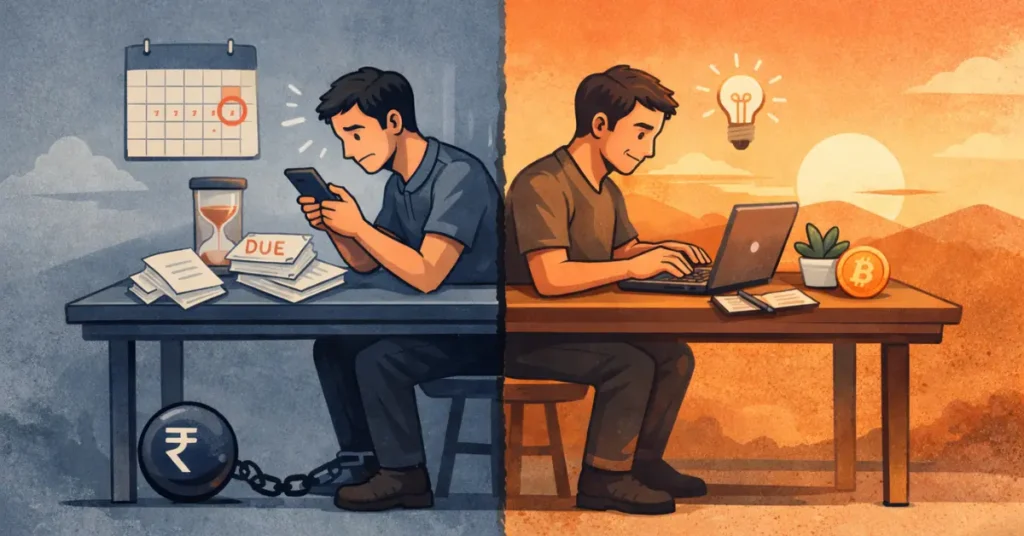
If your income stopped this month, what would actually survives?
Not in theory.
Not on paper.
In real life.
There was a time I believed I was stable.
I had a ₹15,000 salary coming every month, and that felt like control.
Until one month, it didn’t come on time.
Nothing dramatic happened.
But something inside me did.
If my income stops, what actually survives?
Contents
Why a Small Delay Can Reveal Financial Fragility
The salary was delayed by three or four days.
Objectively, that’s nothing.
But I had a credit card bill due.
And I remember feeling irritated in a way that surprised me.
I kept checking my bank app, calculating dates, replaying expenses.
The amount wasn’t the issue. It was the timing.
That’s when something uncomfortable became visible.
If my salary is three days late and I feel this unstable, then I’m not stable. I’m scheduled.
If you’ve felt in control but still dependent, this is where that illusion breaks → Why Financial Security Doesn’t Mean You’re in Control.
The respect I thought I had, the control I thought I had, was hanging on a payment notification.
And that bothered me more than the money itself.
Why Awareness Alone Doesn’t Make You Safer
After that week, I thought clarity would calm me down.
It didn’t.
The next month, I still waited for the salary message.
I still mentally counted how much would remain after bills.
I still structured my spending around a date I didn’t control.
Knowing I was dependent did not reduce the dependency.
That part was frustrating.
I used to think once you “understand” a financial problem, you’re already ahead. But awareness is only mental. Risk is structural.
My structure had not changed.
I was still exchanging time for one source of income and vulnerable to delays.
Nothing had improved. I had just named the problem.
That’s when I realized something uncomfortable:
If income is my only system, then income stopping means everything stops.
That sentence stayed with me longer than I expected.
How I Reduced My Financial Dependence Quietly
I didn’t start earning more.
I didn’t suddenly build a second income stream.
The first thing that changed was smaller.
I reduced my lifestyle quietly, without any dramatic changes.
I just stopped behaving like the ₹15,000 would always arrive exactly on time.
I delayed small purchases.
I stopped upgrading things that still worked.
I became slightly more conservative with my card usage.
Not extreme. Just tighter.
It felt uncomfortable at first.
There’s a strange ego attached to spending freely when you earn. Reducing that felt like admitting something was fragile.
But that irritation from the delayed salary stayed in my memory. And I didn’t want to feel that again.
Nothing magical happened. My income didn’t increase, and the fear didn’t disappear.
But something small shifted.
For the first time, I wasn’t living exactly at the edge of my monthly cycle.
It wasn’t wealth.
It was margin.
And margin is what keeps you standing when income pauses.
What I Started Building Beyond My Salary
Reducing expenses gave me margin.
But margin is not independence.
It only buys time to build it.
I kept asking myself a simple question:
If I don’t show up to work for a month, what continues?
The honest answer was nothing.
So I did two imperfect things.
I started putting small amounts into crypto. Not because I believed it would make me rich. But because it was the first asset I could access with small money. It felt risky. It probably was. But at least it was not tied to my office attendance.
At the same time, I started this blog.
Not as a brand. Not as a business plan.
Just as a place where I could slowly build something that belonged to me.
After work, instead of scrolling or complaining about salary, I started writing. Most days, it felt pointless. No traffic. No money. No validation.
But I kept showing up.
Because for the first time, I wasn’t only working for this month’s credit alert. I was building something that might survive beyond it.
It was slow, and nothing replaced my salary.
I am still dependent.
But now there are small systems forming in the background.
And that changes the feeling slightly.
What Actually Changed (And What Didn’t)
My salary still comes.
I still depend on it.
If it stops tomorrow, I won’t pretend I’m fully protected.
But something is different.
Earlier, income meant identity. If the salary stopped, I felt like I stopped. Respect disappeared. Stability disappeared. My sense of usefulness disappeared.
Now, even though the money hasn’t multiplied, I don’t feel entirely empty outside my job.
There is writing happening.
There are ideas compounding.
There are small assets sitting somewhere, even if volatile.
They are not impressive.
But they exist.
And existence matters.
I am not comparing a delayed salary to suffering. That would be dramatic and dishonest.
But I understood something small from that book.
If everything external pauses, what remains?
For a long time, my answer was: nothing.
Now the answer is: not much, but not nothing.
A reduced lifestyle.
A few risky assets.
A blog that might or might not grow.
A habit of building outside my employer.
It’s not freedom.
It’s just less fragility.
And right now, that is enough.
Why Your Salary Still Matters (But Less Than Before)
On the 1st of every month, I still check my phone.
I still wait for that message.
The difference is not that I don’t care anymore.
The difference is that my entire nervous system is not attached to it the way it used to be.
If it delays, I won’t enjoy it.
But I won’t feel erased either.
Because now, even if slowly, something continues without permission.
A post gets published.
An idea gets written down.
A small investment sits quietly.
A habit compounds.
The salary is still important.
It’s just no longer the only thing keeping me standing.
And maybe that’s the real shift.
Not from employee to entrepreneur.
But from fragile to slightly harder to break.
Try this once:
- If your income stops for 30 days, what continues?
- What expenses still exist no matter what?
- What income (if any) continues without your time?
If my income stops, I won’t be fine.
But I won’t be nothing either.
— If you’ve seen how people can remain steady even when circumstances change, it’s explored deeply in → Man’s Search For Meaning.
And once you see this clearly, you start understanding why stability never felt safe in the first place → Why Financial Stability Doesn’t Feel Safe.
Even after this, something still feels off.
You try to stay consistent, but it doesn’t last.
Not because you lack discipline,
but because of where you’re operating from → Why Discipline Struggles in the Wrong Environment.