

You think you are investing.
You’re probably not.
Most people in the stock market are not investors.
They are reacting.
They check prices every day.
They follow news like it’s a signal.
They buy because someone said, “This will go up.”
And they call this strategy.
The mind is a cage.
It wants certainty in an uncertain game.
So it creates a comforting illusion:
“I know what I’m doing.”
But if your decisions change with price…
you are not investing—
you are reacting.
Table of Contents
What Is Investing vs Speculation (Clear, Practical Meaning)
Investing — Owning a Business for the Long Term
Investing means:
- You buy a real business
- You expect it to grow over time
- You hold through short-term noise
You focus on:
- Revenue
- Profit
- Competitive advantage
This is the foundation of a long-term investing strategy
Speculation — Betting on Price Movement
Speculation means:
- You buy based on price movement
- You expect quick gains
- You rely on timing
You focus on:
- Trends
- Momentum
- Market sentiment
This is closer to trading, not investing
Investing vs Trading vs Speculation — Key Differences
| Factor | Investing | Trading | Speculation |
|---|---|---|---|
| Time Horizon | Long-term (years) | Short-term (days/weeks) | Very short-term |
| Decision Base | Fundamentals | Technicals | Emotion / hype |
| Risk Level | Managed | High | Very high |
| Goal | Wealth creation | Profit from moves | Quick gains |
Most beginners confuse investing vs trading, and unknowingly fall into speculation.
Stocks vs Speculation — 1-Minute Summary
- Investing = Business + Time + Patience
- Speculation = Price + Emotion + Speed
- Investors build wealth
- Speculators chase outcomes
If you remember nothing else, remember this.
Quick Takeaway :
- Investing = Long-term thinking
- Speculation = Short-term reaction
- Investors follow process
- Speculators follow price
Why Most People Drift Into Speculation
This is not a knowledge problem.
It is a behavior problem.
FOMO (Fear of Missing Out)
A stock rises quickly → You feel late → You enter blindly
Illusion of Control
Charts and indicators create confidence… not certainty
Social Media Influence
“Top stocks to buy now”
“Next big opportunity”
Noise feels like opportunity.
Investing vs Speculation in Real Life (With Real Example)
Investing Example — Real Business Thinking
Let’s take Apple Inc..
- Revenue: Hundreds of billions annually (historically ~$300B–$400B range)
- Profit margins: Around mid-20% range
- Strong ecosystem advantage
An investor evaluates:
- Business durability
- Long-term growth
- Reasonable valuation
They buy.
They hold.
Time compounds.
Speculation Example — Hype Cycle
A stock rises 40% in days.
- No business analysis
- No valuation understanding
- Entry based on hype
Outcome:
- Late entry
- Panic exit
- Losses
Not bad luck. No process.
How to Analyze Stocks Like a Smart Investor
You don’t need complexity.
You need clarity.
1. Revenue Growth
Consistent growth = strong business signal
2. Profitability
Profits show sustainability
3. Debt Levels
High debt = higher risk
4. Valuation (P/E Ratio Explained Simply)
- High P/E → expensive
- Low P/E → cheaper (or weak business)
Example:
High valuation + low growth = speculation risk
5. Competitive Advantage
Brand, technology, or network edge
These principles come from Benjamin Graham and are explained deeply in The Intelligent Investor.
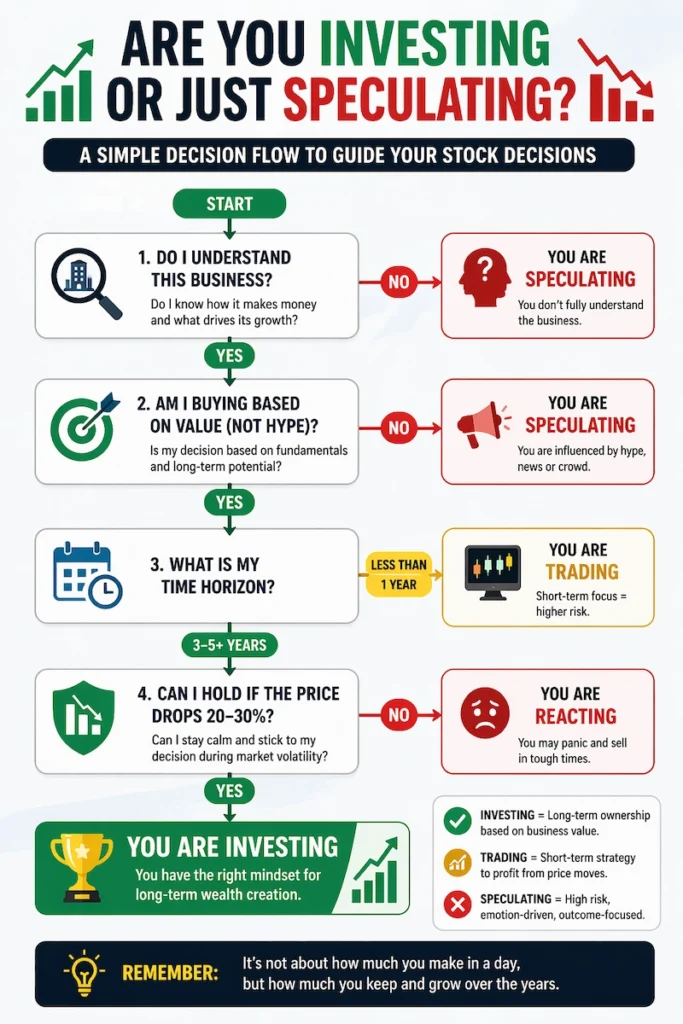
The 3 Filters Rule (Your Decision Framework)
Before buying any stock:
1. Clarity Filter
Do I understand this business?
2. Time Filter
Can I hold this for 5+ years?
3. Risk Filter
What can go wrong?
If a stock fails even one filter… wait.
This is how disciplined investors think—like Warren Buffett.
Before you buy any stock, run it through this decision path.
Data That Most People Ignore (But You Shouldn’t)
Multiple market studies and brokerage reports consistently show:
- Long-term equity markets (e.g., S&P 500) return ~8–10% annually
- 70–90% of short-term traders lose money over time
Translation:
- Investing rewards patience
- Speculation punishes impatience
Figures vary by market and time period, but the pattern remains consistent.
Case Study: Investing vs Speculation Outcome
Scenario:
Investor:
- Invests $1,000 in a strong company
- Earns ~10% annually
- After 10 years → ~$2,600
Speculator:
- Trades frequently
- Faces losses + fees
- Often ends with reduced capital
Outcome:
- Investor builds wealth
- Speculator experiences volatility
Types of Stocks (What Should Beginners Choose?)
- Blue-chip stocks → stable, lower risk
- Growth stocks → higher potential, higher risk
- Value stocks → undervalued opportunities
- Dividend stocks → income-focused
Beginners should start with simple, strong businesses
How to Start Investing (Step-by-Step Beginner Roadmap)
Step 1: Start Small
Learn before scaling
Step 2: Diversify
Reduce risk across stocks
Step 3: Invest Consistently
Build discipline over time
Step 4: Think Long-Term
Compounding needs patience
Step 5: Ignore Noise
Focus on fundamentals
Smart investors don’t just think about returns.
They think about what could go wrong.
That’s why the idea of a margin of safety becomes essential—
buying with a buffer so mistakes don’t destroy you.
7 Warning Signs You Are Speculating
- Buying based on hype
- Checking prices constantly
- Expecting quick profits
- No business understanding
- Panic selling
- Overtrading
- Following the crowd
Awareness is the first shift.
The Pattern You Keep Repeating in the Market
Markets don’t need a crisis to punish behavior.
They do it every day.
A stock rises quickly.
People rush in without understanding.
A stock falls suddenly.
People panic and sell.
Nothing changed in the business.
Only emotions changed.
This cycle repeats quietly—
not once in a decade,
but every single week.
Lesson:
Markets don’t destroy wealth.
Behavior does.
Can Speculation Ever Be Smart?
Yes—but only when controlled.
- Use small capital (5–10%)
- Define exit strategy
- Accept losses
Never confuse speculation with investing
How to Transition from Speculation to Investing
Step 1: Slow Down Decisions
No impulsive buying
Step 2: Write Your Reason
Clarity reduces mistakes
Step 3: Reduce Trading Frequency
Less action → better thinking
Step 4: Focus on Learning
Skill first, profit later
Step 5: Track Your Behavior
Patterns reveal truth
Investor vs Speculator — Mindset Shift
| Investor | Speculator |
|---|---|
| Long-term focus | Short-term focus |
| Research-driven | Emotion-driven |
| Risk-aware | Risk-ignoring |
| Patient | Impulsive |
Final Checklist Before Buying Any Stock
Ask yourself:
- Do I understand this business?
- Why am I buying this?
- What is my time horizon?
- What are the risks?
- Am I following logic or emotion?
- Can I hold through volatility?
Frequently Asked Questions
What is the difference between investing and speculation in stocks?
Investing means buying stocks based on a company’s fundamentals—like revenue, profit, and long-term growth potential. Speculation, on the other hand, is buying stocks based on price movements, trends, or market hype. Investors focus on value and long-term returns, while speculators chase short-term gains.
Is trading the same as speculation in the stock market?
Not always. Trading can be systematic and based on technical analysis, risk management, and defined strategies. Speculation is often less structured and driven by emotion, tips, or hype. However, many beginners confuse trading with speculation because they lack a clear strategy.
How do smart investors decide which stocks to buy?
Smart investors follow a structured process rather than reacting to market noise. They evaluate how a company makes money, whether its revenue and profits are growing consistently, and if it has manageable debt. They also look at valuation metrics like the P/E ratio to avoid overpaying and focus on the company’s long-term potential. This approach, inspired by thinkers like Benjamin Graham, helps them make rational, disciplined decisions instead of emotional ones.
Can beginners lose money by confusing investing with speculation?
Yes. Many beginners lose money because they follow hype, buy trending stocks, or react emotionally to market movements. Without understanding fundamentals or risk, they end up speculating instead of investing. Learning basic stock analysis and long-term strategy can reduce this risk significantly.
What is a safe way to start investing in the stock market?
A safe way to start investing is by focusing on simple and stable businesses that you understand. Instead of chasing quick profits, beginners should invest gradually over time, spread their money across different stocks to reduce risk, and avoid relying on tips or market hype. This disciplined, long-term approach helps build confidence and wealth steadily.
Can you make money from speculation or short-term trading?
Yes, but it is difficult and inconsistent. Studies show that a large percentage of short-term traders lose money over time due to emotional decisions, fees, and lack of discipline. Speculation can generate profits occasionally, but it is not a reliable wealth-building strategy.
What is better for long-term wealth: investing or trading?
For most people, long-term investing is better. It allows compounding to work over time, reduces stress, and avoids frequent decision-making errors. Trading requires high skill, discipline, and experience, while investing is more sustainable for building wealth steadily.
If You Remember Only One Thing
Investing = Process
Speculation = Reaction
Final Insight — The Real Battle Is Internal
The market is not your enemy.
It does not control you.
It reflects you.
Your fear
Your greed
Your impatience
If you truly want to shift from reacting to building real wealth,
Think Like a Long-Term Investor to Build Real Wealth
Because wealth is not built by reacting fast,
but by thinking clearly and staying patient.