
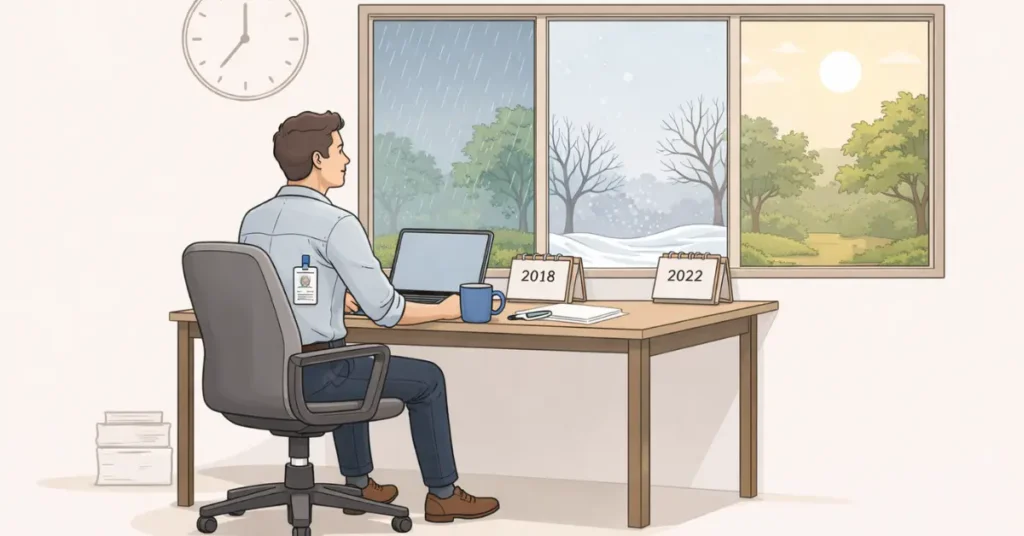
Working hard should move life forward.
But for many people, it doesn’t
Days stay full.
Effort stays high.
Still, progress feels unclear.
This is not about failure.
It’s about understanding what your effort is actually doing.
Contents
When Progress Becomes Hard to Feel
At some point, many people notice something quietly unsettling.
You keep doing what’s expected. But nothing really changes.
Life keeps moving,
but it does not feel like it is moving forward.
The routine changes slightly.
Responsibilities increase.
Income adjusts a little.
Yet the larger picture stays familiar.
This is not failure.
And it is not crisis.
It is the slow realization that time is passing,
but the shape of life is not changing as much as expected.
Which makes the feeling harder to explain.
On paper, everything looks fine.
People often describe it simply as,
“I thought things would feel different by now.”
That quiet gap between expectation and reality
is where this begins.
Why Effort Often Fails to Create Movement
Most effort is designed to keep things running.
It helps you stay employed.
It helps you meet expectations.
It helps you avoid immediate problems.
In that sense, effort works.
It creates stability.
But stability is not the same as movement.
This is why working hard can steel feel like going nowhere.
And most people never notice the difference.
Being busy changes how full your days feel.
It does not automatically change where you are over time.
This is the part many people miss.
They assume that if activity stays high, progress must be happening somewhere in the background.
Often, it isn’t.
You stay busy → things feel stable → you assume progress → nothing actually shifts.
Effort improves comfort within a position, not the position itself.
It rarely changes the position itself.
The routine gets smoother.
The risks feel controlled.
But the direction stays largely the same.
This is why years can pass without a clear sense of advancement.
Work absorbs energy.
Responsibility absorbs attention.
Nothing is broken.
Nothing is failing.
Effort is simply doing the job it was designed to do.
Keeping things going.
Not moving them forward.
If you haven’t seen why this happens → Hard Work Without Leverage Limits Your Income.
When Staying Busy Replaces Stepping Back
This pattern is easy to miss while you are inside it.
Busy days leave little room for reflection.
Tasks create urgency.
Responsibilities demand attention.
So life is managed one week at a time.
I ran into this myself.
I stayed focused on doing my work well and meeting expectations.
As long as things were stable, I assumed progress was happening somewhere underneath.
It wasn’t obvious that anything was wrong.
Income was coming in.
Life was functioning.
There was no single reason to stop and reassess.
But over time, I noticed something uncomfortable.
The effort required to maintain the same life kept increasing.
Yet the sense of movement did not.
Looking back, the mistake was subtle.
I was using busyness as proof of progress.
As long as my days were full, I assumed my direction was right.
That assumption delayed clearer thinking.
Staying busy felt responsible.
But it quietly replaced thinking.
Stepping back felt unnecessary.
Until the gap became hard to ignore.
This is how people remain stuck without realizing it.
Not because they refuse to change,
but because constant activity leaves no space to question where that activity is leading.
The problem is not effort. It’s what your effort is doing every day.
A Simple Way to Think About Progress
A useful way to understand this is to separate activity from position.
Activity is what fills your days.
This is what most of your time goes into.
- Tasks
- Meetings
- Deadlines
- Responsibilities
Position is where you stand over time.
- How much choice you have
- How dependent life feels on constant effort
- How easily you can pause without everything breaking
Most people never check this. They just stay busy.
Most work increases activity.
Very little work changes position.
This is the hidden difference between being busy and making progress.
This is why people can be extremely active and still feel stuck.
They are optimizing inside a position,
not changing the position itself.
Activity answers the question:
“What did I do today?”
Position answers a different question:
“Where am I heading if this continues for years?”
When those two drift apart, discomfort appears.
Life feels busy but direction feels unclear.
The mistake is assuming that more activity will eventually fix the position.
Sometimes it does.
Often, it doesn’t.
Because activity is rewarded immediately.
Position changes slowly.
Without consciously noticing the difference, it is easy to spend years improving how things run,
without changing where they lead.
Seeing this clearly does not demand action.
It does not require urgency.
It simply replaces confusion with understanding.
Why This Realization Comes Late
This pattern rarely announces itself clearly.
Nothing breaks.
Nothing collapses.
Life continues to function.
Small improvements keep things comfortable enough.
A slightly better salary.
A few lifestyle upgrades.
More stability than before.
These changes reduce pressure.
They also delay questioning.
Because discomfort is low, urgency stays low.
Progress is evaluated year by year, not across decades.
As long as things are a little better than last year, the larger direction is rarely examined.
Long-term studies from the OECD show that incremental improvements in work and income often coexist with limited changes in overall life mobility, especially over long time horizons.
There is no single moment that says,
“Stop. Look again.”
Instead, the realization arrives slowly.
Often much later than expected.
Not because people are careless,
but because the absence of crisis feels like success.
Stagnation hides inside normal life.
By the time the feeling becomes clear,
years have already been spent maintaining a direction that no longer feels right.
This is why the confusion feels heavy.
It is not about one decision.
It is about many years that seemed reasonable at the time.
Pause and check this:
- What did your effort actually change in the last 30 days?
- Are you improving your position or just maintaing it?
- If you repeat this for 2 years, where will you be?
A Calm Close
It creates stability.
It meets expectations.
It reduces immediate risk.
But stability alone does not guarantee movement.
This is why people can stay busy for years
and still feel unsure about where life is heading.
The issue is not effort.
And it is not a lack of discipline.
It is the quiet assumption that activity will eventually turn into progress on its own.
Seeing this clearly changes the tone of the conversation.
It shifts attention away from self-blame
and toward understanding how time, effort, and direction interact.
There is no urgency here.
No demand to change everything.
Just a clearer way of noticing what has been happening.
And sometimes, that clarity is enough to make progress feel possible again.
— If you want to understand how to move beyond this → The Almanack of Naval Ravikant
If this feels real, the next step is not more effort, it’s changing how you act daily → Stop Working Harder and Start Building Better Systems.