
The discipline that protects your capital… when your mind becomes your biggest risk.
You are not afraid of a market crash.
You are afraid of seeing your illusion collapse.
You call it volatility.
In reality, it is exposure.
Exposure of your impatience.
Your need to act.
Your habit of confusing price with value.
You didn’t buy a business.
You bought a story.
And when the story breaks…
the market doesn’t punish you.
It reveals you.
This is why the margin of safety rule exists.
Every loss in investing begins when price is mistaken for value.
Table of Contents
What Is Margin of Safety?
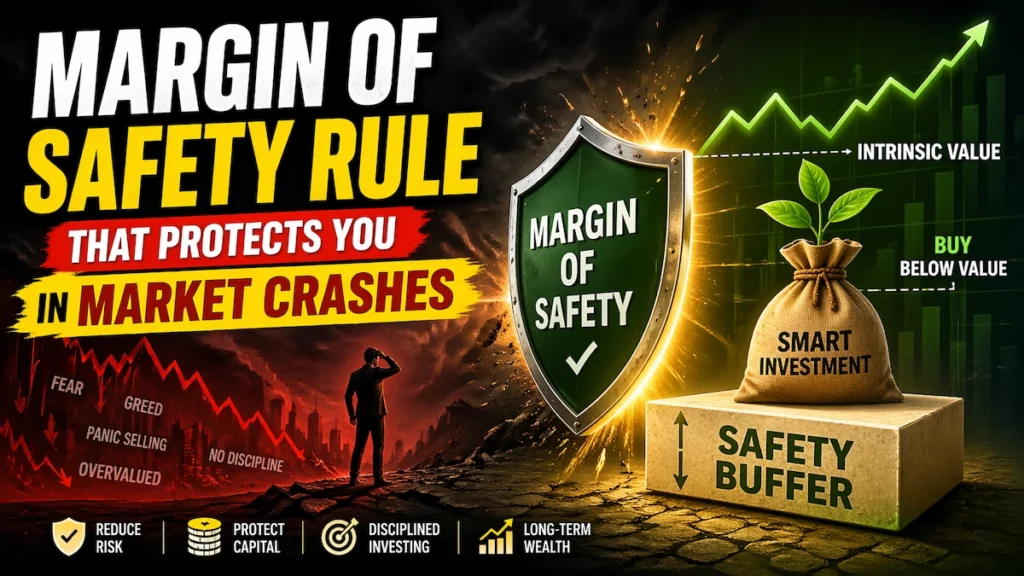
Margin of safety is the difference between an asset’s intrinsic value and its market price. It helps investors reduce risk by buying below true value, providing a buffer against uncertainty and losses.
What Is Margin of Safety Rule in Investing?
The concept comes from Benjamin Graham and is deeply explained in The Intelligent Investor.
Margin of Safety = Buying an asset significantly below its intrinsic value.
If something is worth $100 and you buy it at $70,
you create a 30% safety buffer.
This buffer protects you from:
- valuation mistakes
- unexpected risks
- emotional decisions
As Warren Buffett applies in practice,
investing is not about being perfectly right—
it is about avoiding big mistakes.
Why Investors Lose Money (Before the Crash Even Happens)
Most investors believe losses happen during crashes.
They don’t.
Losses begin when:
- you chase rising prices
- you ignore valuation
- you follow the crowd
This behavior pattern is explained deeply here:
Why Investors Panic Buy and Sell (Cycle Explained)
That cycle is emotional.
Margin of safety is rational.
Price vs Intrinsic Value — The Only Distinction That Matters
Short-term prices move on:
- sentiment
- liquidity
- narratives
Intrinsic value depends on:
- earnings
- cash flow
- business quality
Short-term prices are driven by sentiment, liquidity, and narratives.
Intrinsic value is driven by earnings, cash flow, and business fundamentals.
In the short term, price can deviate wildly.
Over time, it tends to reflect value—though timing is uncertain.
This gap is where both risk and opportunity are created.
How to Calculate Margin of Safety (Step-by-Step)
Formula :
Margin of Safety = (Intrinsic Value – Market Price) ÷ Intrinsic Value
Example :
- Intrinsic Value = $150
- Market Price = $100
- Margin of Safety = 33%
This buffer protects you from being wrong.
How to Calculate Intrinsic Value (Beginner to Practical Level)
You don’t need complex financial models to start.
But you do need structured thinking.
1. Earnings-Based Approach
- EPS × reasonable P/E ratio
Example:
- EPS = $5
- P/E = 15
- Intrinsic Value ≈ $75
2. Conservative Growth Approach
- Assume lower future growth
- Avoid optimistic projections
Important Note :
This is a simplified method.
Professional valuation may include cash flow analysis and discounting.
The goal here is not precision.
The goal is avoiding overvaluation.
What Is a Good Margin of Safety?
| Investment Type | Margin of Safety |
|---|---|
| Stable companies | 20–30% |
| Moderate uncertainty | 30–40% |
| High uncertainty / cyclical | 40–50%+ |
The more uncertain the business,
the bigger your safety margin should be.
How Margin of Safety Protects You in Market Crashes
Scenario A — No Margin of Safety
- Buy at $150
- Value = $100
- Price drops to $90
Loss ≈ 40%
Scenario B — With Margin of Safety
- Buy at $70
- Value = $100
- Price drops to $90
Still safe or profitable
Data Insight (Important)
Historically, across multiple market cycles, stocks bought at lower valuations tend to experience smaller drawdowns and recover faster over time.
For example, stocks purchased at high valuations often face 30–60% corrections when expectations normalize, while undervalued stocks typically show more resilience during downturns.
Studies in value investing also suggest that buying at lower valuation multiples leads to better long-term risk-adjusted returns, especially when combined with strong business fundamentals.
The insight is simple:
The price you pay determines how much risk you carry.
5-Year Outcome Comparison
| No Margin of Safety | With Margin of Safety | |
|---|---|---|
| Entry Price | $150 | $70 |
| Crash Impact | Severe loss | Controlled |
| Emotional Reaction | Panic sell | Hold / buy more |
| Long-Term Return | Weak | Strong compounding |
At this point, the question is not whether the market will crash…
but whether you are protected when it does.
Same market.
Different decision.
Different future.
Real-World Pattern: Great Company, Bad Investment
In real markets:
- A strong company becomes popular
- Price rises faster than fundamentals
- Investors enter late
Then:
- expectations normalize
- valuations compress
- prices fall sharply
Investors often face 30–60% declines in such situations.
The business may still be good.
But the investment fails because the entry price was too high.
Investor Psychology: The Real Enemy
Even when people understand this rule…
they ignore it.
Why?
Because of:
- fear of missing out
- herd mentality
- emotional investing
This leads investors to buy at inflated prices and ignore valuation risk.
The market doesn’t defeat you.
Your behavior does.
Quick Checklist: How to Analyze Stocks Before Buying
Before applying margin of safety:
- consistent revenue growth
- stable profit margins
- manageable debt
- competitive advantage
- trustworthy management
Margin of safety cannot fix a weak business.
Where to Find Data (Practical Execution)
Use:
- annual reports
- financial statements
- earnings reports
- stock screeners
Focus on:
- EPS
- growth rate
- margins
- debt levels
Sector Reality: Margin of Safety Is Not Universal
Stable Businesses
- predictable
- lower safety margin
Growth Stocks
- uncertain
- higher safety margin
Cyclical Industries
- volatile
- require maximum margin
Portfolio-Level Strategy (Advanced Layer)
Margin of safety is not just about one stock.
At portfolio level:
- diversify across sectors
- size positions carefully
- avoid concentration risk
Protection must exist across the entire portfolio.
When Margin of Safety Fails
It is powerful—but not perfect.
It can fail due to:
- value traps
- structural decline
- wrong assumptions
- poor governance
It reduces risk, but incorrect assumptions can still lead to losses.
Margin of Safety vs Other Strategies
| Strategy | Limitation |
|---|---|
| Diversification | Doesn’t fix overvaluation |
| Stop-loss | Reacts after loss |
| Margin of Safety | Prevents loss before entry |
Truth vs Lie — Market Myths
| Myth | Reality |
|---|---|
| Good company = good investment | Price matters |
| Buy fast or miss out | Opportunities return |
| Volatility = risk | Permanent loss is risk |
| Activity = profit | Discipline = profit |
Does Margin of Safety Still Work Today?
Yes.
Because markets are still driven by:
- human psychology
- cycles of greed and fear
- mispricing
As long as price and value differ…
this strategy will remain relevant.
How to Apply Margin of Safety Rule (Step-by-Step)
- Identify a strong business
- Estimate intrinsic value
- Apply safety margin
- Wait for undervaluation
- Invest with discipline
- Review without emotional reaction
Do This Before Your Next Investment
Before you invest your next dollar:
- Pick one stock
- Estimate its intrinsic value
- Compare it with the current market price
Then ask yourself:
Where is my margin of safety?
If it doesn’t exist…
The opportunity doesn’t exist.
Because in investing,
doing nothing is often the smartest decision.
Frequently Asked Questions
What is margin of safety in stock market?
Margin of safety is the difference between intrinsic value and market price. It helps investors reduce risk by buying below true value, providing a buffer against losses during market volatility.
How to calculate margin of safety?
Margin of safety is calculated using the formula:
( Intrinsic Value – Market Price ) ÷ Intrinsic Value.
This helps investors understand how much downside protection they have before investing.
Why is margin of safety important in investing?
It protects against permanent loss of capital by reducing the risk of overpaying. It also provides downside protection during market corrections and uncertainty.
What is a good margin of safety?
A margin of safety between 20% to 50% is generally considered good, depending on the business quality and level of uncertainty involved.
Final Insight
You cannot control markets or predict outcomes.
But you can control the price you are willing to pay—and that decision defines your risk.
And over time…
that decision decides everything.
What to Read Next
Stocks vs Speculation: How Smart Investors Decide
Because in the end—
The difference between wealth and loss
is not the market.
It is the decision behind the trade.