
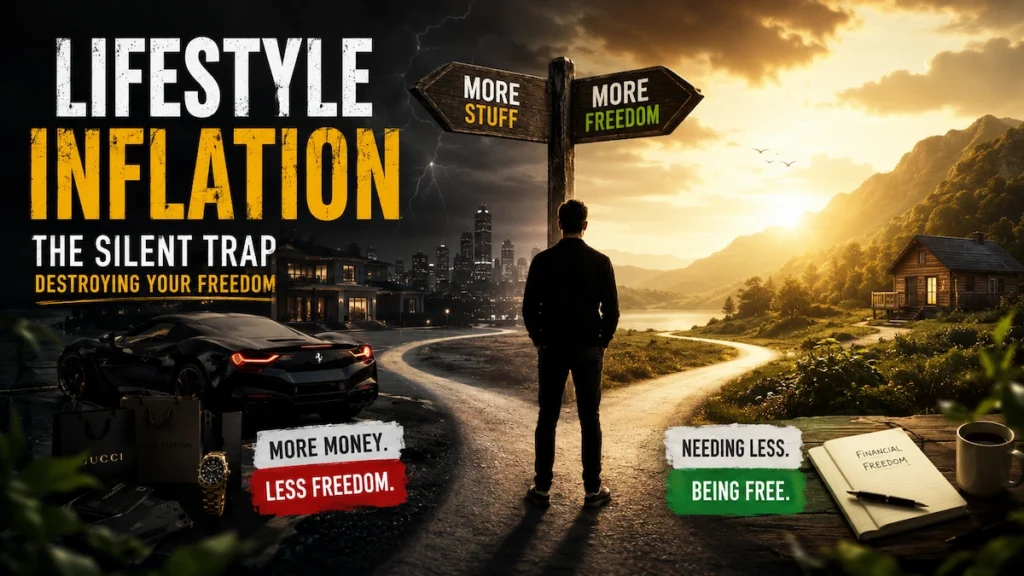
To avoid lifestyle inflation, detach your self-worth from spending.
Escape the hedonic treadmill by defining your “point of enough.”
Automate savings before upgrading your lifestyle.
And remember:
Most luxury upgrades are not freedom.
They are ego maintenance disguised as success.
The more your lifestyle grows,
the more your freedom quietly shrinks.
The treadmill is a mathematical trap dressed in spiritual clothing.
It is the ego’s most efficient mechanism for keeping you in a state of perpetual poverty, regardless of your income.
You believe your new salary is a ladder, but without consciousness, it is merely a longer chain.
If you buy a luxury you cannot walk away from tomorrow, you don’t own it—it owns you.
Most “success” is just a high-status prison where you trade your finite life for the hollow maintenance of objects designed to impress people you don’t even like.
Real power is the cold, surgical ability to remain ordinary while your bank account becomes extraordinary.
Step off the treadmill.
The only person who can never be bribed or enslaved is the one who has already decided that they have enough.
Contents
What Is Lifestyle Inflation? The Trap Nobody Notices
Lifestyle inflation is the silent expansion of your “needs” to match your greed.
It is a slow, creeping vine that strangles your freedom while you are busy celebrating a promotion.
Most people think lifestyle inflation is about buying a Ferrari; it isn’t.
It’s about the “upgraded” coffee, the slightly better gym membership, and the “premium” subscription that you didn’t need yesterday but can’t live without today.
You think you are moving forward, but you are merely building a more expensive cage with thicker bars.
Why Earning More Often Creates More Stress
Success, for the unconscious mind, is a drug.
When you get a raise, the ego demands a new theater to perform in.
You buy a bigger house, a faster car, a shinier watch.
But here is the cold truth:
You don’t just have a job; you now have a maintenance bill.
Your life’s energy is no longer spent on exploration or joy; it is spent on keeping your objects from being repossessed.
The more you “have,” the more you have to lose.
Fear is the shadow of every luxury you cannot walk away from.
You aren’t working for a salary anymore; you are working to pay off the ghost of your own status.
The Hedonic Treadmill: Why Satisfaction Never Lasts
The treadmill is a biological prank designed to keep the species moving, but it will kill the individual’s peace.
It operates on a cycle of “Dopamine Exhaustion.”
When you reach a new peak, your brain recalibrates.
What was a luxury yesterday becomes the “baseline” today.
The Spike:
You get a $2,000 bonus.
For 48 hours, you feel like a King.
The Normalization:
Within a month, that extra money is absorbed into your bills.
You are now a King who is worried about his electricity bill.
The Void:
You feel the same emptiness you felt when you were broke, but now you need $10,000 to get that same 48-hour hit.
You are running faster, but the scenery hasn’t changed.
The Real Cause of Lifestyle Inflation Is Identity
You are not buying leather seats; you are buying a mask because you are afraid of your own nakedness.
People Don’t Buy Things. They Buy Psychological Validation
If you were the only person on Earth, would you still buy that designer watch?
The answer is a cold, hard “No.”
You buy it so that the “Other”—neighbors, colleagues, strangers—looks at you and thinks you are significant.
You are paying for a stranger’s fleeting, 2-second thought with your finite life energy.
You are trading hours of your soul for a nod of approval from someone you don’t even like.
That is not an investment; that is a tragedy.
The Fear of Looking ‘Unsuccessful’
To the ego, being “ordinary” is a fate worse than death.
Society has taught you that your net worth is your self-worth.
So, you inflate your life to prove you have “made it.”
But a truly powerful person—knows that invisibility is the ultimate leverage.
When the world cannot see your wealth, the world cannot put a price on your head.
Real power is having a million-dollar bank account while wearing a ten-dollar shirt.
Truth vs. Lie: The Lifestyle Inflation Illusion
| The Lie (The Ego) | The Truth (The Soul) | The Logical Outcome |
|---|---|---|
| “I worked hard; I deserve to treat myself.” | “I worked hard; I deserve to be free, not in debt.” | Long-term slavery for short-term pleasure. |
| “This purchase will make my life easier.” | “This purchase will require more of my time to maintain.” | You become a servant to your objects. |
| “People will respect my success.” | “People will envy my possessions, not my character.” | Envy is a target; respect is a shield. |
The Cold Logic: How to Outsmart the Ego
To escape the treadmill, you must stop being a “consumer” and start being a “strategist.”
You must look at your finances with the cold eyes of a predator.
Use this formula to measure your actual power:
If your income is $1,000,000 but your ego requires $999,000 to feel “successful,” you are a beggar.
You are one bad month away from total collapse.
But if your income is $50,000 and your ego requires only $20,000, you are a God.
You have 30,000 units of “unfuck-withable” freedom.
The Treadmill Test (3 Brutal Questions)
Before you sign that lease or swipe that card, subject the purchase to this interrogation.
The Invisibility Test:
If I were forbidden from ever showing this item to another human being, or posting it on social media, would I still want it?
The Maintenance Test:
How many hours of my life must I trade every month just to keep this item in my possession?
Is the object worth the heartbeat?
The Exit Test:
Does this purchase make it harder for me to quit my job tomorrow?
If yes, you are buying a shackle.
How to Avoid Lifestyle Inflation at the Root
Increase Your Savings Before You Upgrade
The moment the money hits your account, your ego begins to lobby for it.
You must act before the “lawyer” speaks.
The 70% Rule:
Take 70% of every raise, bonus, or profit and automate it directly into your “Freedom Fund.”
Never let that money sit in your checking account.
If you never “see” the money, you cannot “feel” like you have it, and your lifestyle will naturally remain lean.
Practice Invisible Wealth
There is a profound joy in being “The Richest Person in the Room” whom everyone assumes is just an average guy.
This is the philosophy of the millionaire next door.
Drive the older car:
Let them think you are struggling.
It keeps the parasites away.
Keep the simple house:
A small house is easy to clean, easy to heat, and leaves you with a large garden of peace.
The less the world knows about your wealth, the more of it belongs to you and not your reputation.
The Spiritual Cost: The More You Need, The More Fear Controls You
A man who needs a mansion is a man who can be blackmailed by his boss, his bank, and his society.
He is a hostage.
A man who is happy in a simple room with a book and a view of the trees is a man who can speak the truth.
He cannot be bought.
He cannot be intimidated.
Desire expands faster than income.
If you don’t kill the desire at the root, no amount of money will ever be enough.
Financial freedom does not begin when you have “more”; it begins the moment you decide to need “less.”
Luxury, Desire, and the Fear of Being Ordinary
Do You Need to Kill Every Desire?
No.
The problem is not the Ferrari.
The problem is unconsciousness.
A Ferrari bought from joy is different from a Ferrari bought to repair self-worth.
One is play.
The other is compensation.
Most people are not chasing the object itself; they are chasing the emotional medicine attached to it.
And this is why they remain empty even after getting what they wanted.
You do not need to crush desire.
Crushed desires become psychological ghosts.
They return later as:
- envy,
- obsession,
- resentment,
- or reckless consumption.
The goal is not repression.
The goal is awareness.
Before every luxury, ask yourself:
“What is this desire trying to repair inside me?”
That single question can save you years of unconscious suffering.
The Real Question: Would You Still Want It in Silence?
If nobody could see the car…
If nobody could admire the watch…
If social media did not exist…
Would you still want it?
Be honest.
Most luxury purchases are not about utility.
They are about identity.
People want the feeling attached to the object:
- significance,
- superiority,
- validation,
- attention,
- proof that they matter.
The object is physical.
The hunger is psychological.
And psychological hunger has no finish line.
How to Need Less in a World Obsessed With Status
Yes, society respects visible success.
That is reality.
Humans are tribal creatures.
Status changes how people treat you.
But there is a hidden danger in building your identity around external validation.
The moment your self-worth depends on admiration, strangers begin controlling your nervous system.
One compliment lifts you.
One richer person destroys your peace.
That is emotional slavery disguised as ambition.
The world teaches you to look successful.
Very few people learn how to feel complete without performing success.
And that is why so many high earners secretly feel exhausted.
Real Wealth Is Enjoying Luxury Without Needing It
Needing less does not mean rejecting beauty.
It does not mean becoming anti-money or anti-success.
It means your peace is no longer dependent on constant upgrading.
You can enjoy luxury without worshipping it.
You can own beautiful things without using them to prove you are beautiful.
That is mastery.
A person who needs less feels powerful because they can walk away.
They are harder to manipulate.
Harder to control.
Harder to enslave through fear and maintenance.
Ironically, the people who no longer desperately seek status often radiate the deepest form of power.
Quiet power.
The kind that says:
“I can afford to impress you.
I simply no longer need to.”
Final Thoughts: Step Off the Track
Do not wait until you are 60 to realize that you spent your entire youth polishing the bars of a golden prison.
The treadmill only stops when you decide to stop running.
Be the master of your success, not its servant.
The world wants you to spend so it can own you.
Disappoint the world.
Choose freedom.
Are you ready to be ordinary and free, or extraordinary and enslaved?
What’s Next?
Stepping off the treadmill is a psychological choice. Staying off is a strategic one. If you are ready to move from philosophy to execution, your next step is mastering The Anatomy of the Gap: What Living Below Your Means Really Means.
Frequently Asked Questions
What is lifestyle inflation?
Lifestyle inflation happens when your spending increases as your income grows. Instead of building wealth, higher earnings slowly turn into higher expenses, making financial freedom harder to achieve.
What causes lifestyle inflation?
Lifestyle inflation is usually caused by social comparison, rising expectations, emotional spending, and the hedonic treadmill. As people adapt to a higher income, luxuries slowly become psychological “needs.”
Is lifestyle inflation always bad?
No. The problem is not upgrading your life; the problem is becoming emotionally dependent on constant upgrades. Conscious spending creates freedom. Unconscious spending creates pressure.
How do wealthy people avoid lifestyle inflation?
Many wealthy people practice invisible wealth. They increase investments faster than expenses, avoid status-driven purchases, and focus on freedom instead of appearing rich.
What is the hedonic treadmill?
The hedonic treadmill is a psychological phenomenon where people quickly adapt to improvements in income, lifestyle, or possessions, causing happiness from upgrades to fade over time.
How can I stop lifestyle creep after a salary increase?
One of the best ways to stop lifestyle creep is to automate savings and investments immediately after getting a raise. This prevents your lifestyle from expanding as quickly as your income.