
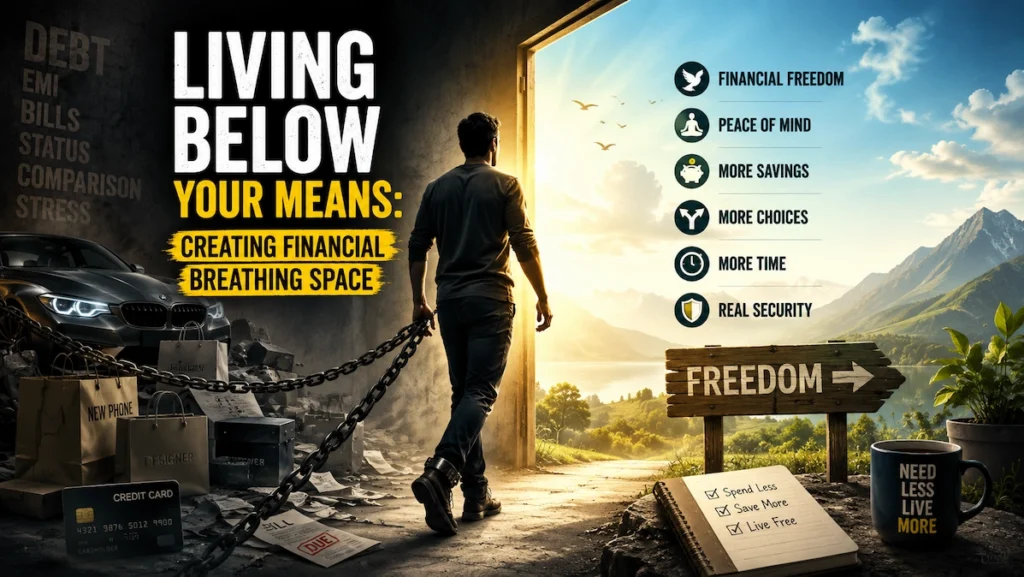
To live below your means is the strategic act of spending less than you earn to create financial breathing space.
This “gap” provides the oxygen needed to escape the stress of paycheck-to-paycheck living. It neutralizes lifestyle inflation and builds a foundation for true autonomy.
Your bank account is a mirror of your enslavement.
Most people don’t own things; their things own them. They expand their “lifestyle footprint” until there is no room left to move.
They call it success. I call it a slow-motion suffocation.
You have been trained to view a paycheck as a permission slip to consume. But every time you raise your “floor” to meet your “ceiling,” you are welding your own cage shut.
True power doesn’t look like a luxury car. True power is the silence of an unspent dollar.
It is the “Gap”—that invisible territory between what you earn and what you actually need.
While the world is busy decorating its prison cells, the wise man is busy expanding his breathing space.
Living below your means isn’t an act of restriction. It is the calculated accumulation of “No.”
The bigger your breathing space, the less the world can dictate your heartbeat.
If you cannot stop working today without your world collapsing tomorrow, you aren’t successful.
You are just a high-status hostage.
It’s time to stop buying your way into a cage and start breathing your way into freedom.
True luxury isn’t the ability to buy everything you want; it is the power to need nothing the world is selling.
The Anatomy of the Gap: What Living Below Your Means Really Means
Most people think saving money is about deprivation. They are wrong. It is about spatial awareness.
True wealth building habits are not found in the accumulation of gold, but in the preservation of the void.
When you spend less than you earn, you are not missing out. You are creating a buffer of silence.
This is the anatomy of the gap: the distance between your survival and your ego.
| The Status Game (Suffocation) | The Freedom Game (Breathing) |
| Income = Expenses | Income > Expenses |
| Life is a high-speed treadmill | Life is a calm walk |
| Motivation comes from fear of loss | Motivation comes from desire to create |
| Assets are visible and depreciate | Assets are invisible and appreciate |
| Vulnerable to every economic whim | Immune to external chaos |
The Gilded Cage: Why Most People Feel Financially Suffocated
Society is a factory designed to produce consumers, not individuals. You are taught that intentional living is boring, while money stress is a normal byproduct of “making it.”
You earn more, yet you breathe less. You have mistaken a larger cage for a larger world. This is why you feel suffocated—not because you don’t have enough, but because you have no room to move within what you have.
If your salary doubles and your stress doubles with it, you haven’t been promoted. You’ve been recalibrated for a deeper level of servitude.
The Silent Thief: How Lifestyle Inflation Destroys Future Autonomy
There is a thief that lives in your shadow: lifestyle inflation. It waits for every raise and promotion, whispering that you “deserve” more.
By the time you realize what has happened, your financial independence has been traded for a collection of polished glass and leather. You have traded your future autonomy for a present-day illusion. To fight the thief, you must decide that your freedom is worth more than a new upholstery scent.
Oxygen for the Soul: Why Financial Breathing Space Changes Everything
Financial breathing space is the only currency that matters. It is the ability to wake up and realize that your boss, your neighbors, and your creditors have no power over your pulse.
This isn’t just about financial peace; it is about reclaiming your soul. When you have oxygen, you can think. When you can think, you can choose. Most people cannot choose; they can only react to the next bill.
The Symptoms of Suffocation: Signs You’re Living Beyond Your Means
How do you know if you are drowning? The signs are quiet before they are loud:
- Paycheck to Paycheck: Your survival depends on the next 30 days of labor.
- The Upgrade Cycle: You cannot receive more money without finding a way to get rid of it.
- The Debt Fog: You use tomorrow’s labor to pay for yesterday’s junk.
- Panic over shrugged shoulders: A job loss feels like a death sentence.
The Tale of Two Paths: A Strategic Comparison
To understand the power of the Gap, look at two individuals earning the same global salary of $5,000/month. This is the phenomenon famously documented in The Millionaire Next Door: the reality that the people with the most wealth are often the ones who look the most ordinary.
Path A: The High-Status Hostage
- The Logic: Every raise is a reason to upgrade.
- The Lifestyle: A $1,500 apartment, a $600 car payment, $1,000 on dining/social status, and $1,900 on “miscellaneous” comforts.
- The Result: Total expenses hit $5,000.
- The Reality: Despite earning a high income, their Oxygen Score is Zero. If their boss disrespects them, they must stay silent. They are a slave in a polished suit.
Path B: The Ghost in the System
- The Logic: Maintain the Artificial Ceiling from three years ago.
- The Lifestyle: A $1,000 apartment (modest but safe), no car payment (buys used/cash), $500 on high-quality food, and $500 on meaningful experiences.
- The Result: Total expenses are $2,000.
- The Gap: $3,000 of “Invisible Wealth” every single month.
- The Reality: Within one year, this person has $36,000 in their “Oxygen Tank.” They can stop working for 18 months without changing their life. They are the most dangerous person in the room because they don’t need the room.
The Architecture of Invisibility: Your Execution Framework
To solve the problem of suffocation, you must re-engineer your reality. This is a psychological divorce from the status game.
1. The Artificial Ceiling
Identify a year from your past when your income was lower but your basic needs were met. That is now your Hard Ceiling. Regardless of how much you earn today, you are forbidden from moving that ceiling. Any income above that line is “dead money.” You aren’t saving it; you are burying it so it cannot be used as leverage against you.
2. The Death of the Mirror
Perform a Status Audit. Review every recurring expense and ask: “If I lived in total isolation, would I still pay for this?” If the answer is no, it is a parasitic expense. Cut it. You are killing the ego that requires external validation.
3. The Liquidity of Silence
Move your breathing space into “Dark Pools”—accounts you cannot access via an instant app or a card. Friction is your ally. By creating a three-day delay between your impulse and your money, you allow the animal “need” to consume to wither and die.
4. The Practice of Hardship
Engage in Voluntary Hardship. For one week every month, live at your absolute survival floor. Eat simply, remove digital entertainment, and walk instead of drive. You prove to your subconscious that you can survive on nothing. Once you lose the fear of being “broke,” the world loses its leverage over you.
The Art of the Minimum: Living Below Your Means Without Feeling Miserable
Mindful spending is the art of the surgeon, not the monk. You identify the 20% of spending that brings 80% of your joy and ruthlessly cut the rest.
This isn’t about being “cheap”—it’s about being focused. You aren’t saying “No” to the ice cream; you are saying “Yes” to your own life.
The Great Deception: Truth vs. Lies in the Status Game
You may ask: “What is the point of living if I can’t enjoy a drink or a new phone? Aren’t we here to enjoy life?”
This is the great deception. You are confusing freedom with consumption. Most people aren’t “enjoying” their spending; they are self-medicating. If you need a “hit” of sugar or a new screen to survive your work week, you aren’t enjoying life—you are using a sedative to forget that you are trapped.
Existence is not about being a processor of commodities. You were born to experience Presence. And you cannot be present if you are constantly anxious about the cost of your existence.
The Ultimate Status Symbol: Why the Real Luxury Is Space
In an age of noise, silence is luxury. In an age of clutter, space is luxury.
The real status symbol is not the car in the driveway, but the years of freedom in the bank. The real luxury is financial breathing space. It is the ability to sit in a room, doing nothing, and knowing that you are completely safe.
True luxury isn’t the ability to buy everything you want; it is the power to need nothing the world is selling.
Next: Spending vs Saving: Every Dollar Is a Vote for Your Future
Frequently Asked Questions
Is living below your means the same as being cheap?
No. Living below your means is about conscious spending, not deprivation. The goal is to create financial breathing space by spending intentionally instead of emotionally.
Why is living below your means important?
Living below your means reduces financial stress, helps you avoid lifestyle inflation, and creates the freedom to save, invest, and handle emergencies without panic.
How can I start living below my means?
Start by lowering unnecessary fixed expenses, avoiding lifestyle upgrades after salary increases, and spending less than you earn consistently. Small gaps create long-term financial freedom.
What is financial breathing space?
Financial breathing space is the gap between your income and your actual cost of living. It gives you flexibility, reduces dependence on every paycheck, and increases financial security.
What are signs you are living beyond your means?
Common signs include living paycheck to paycheck, relying on debt, constantly upgrading your lifestyle, and feeling anxious about missing a paycheck.
How does lifestyle inflation affect wealth?
Lifestyle inflation quietly increases your expenses every time your income rises. Over time, it destroys savings potential and keeps people financially dependent despite earning more money.