
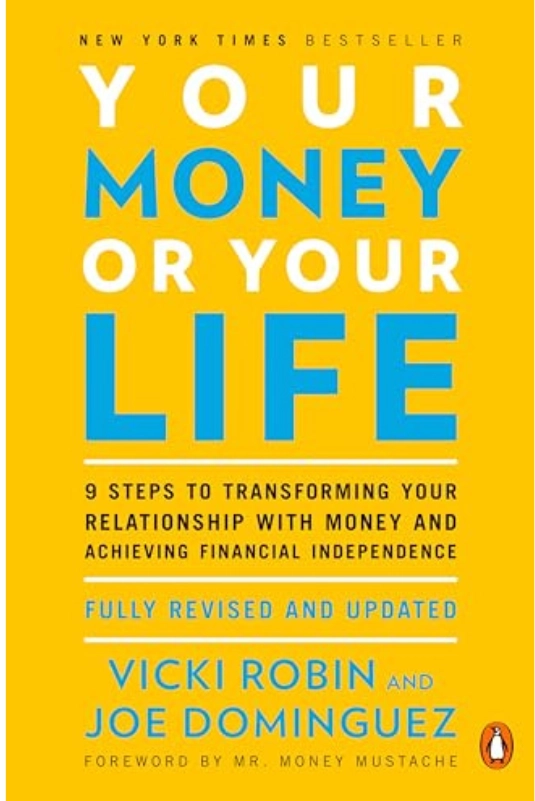
Author: Vicki Robin and Joe Dominguez
Read Time: 5.5 Hours
Moneygatha Rating: ⭐⭐⭐⭐⭐ (5/5)
The Lesson: Money = Your Life Energy (Time)
The Verdict: This is the ultimate blueprint for Financial Independence (FI). If you are tired of the endless 9-to-5 rat race and feel like your job is consuming your entire existence, this book will completely rewire how you look at money. It gives you a brutal reality check and a 9-step practical system to buy back your freedom and time.
Your Money or Your Life by Vicki Robin and Joe Dominguez
A legendary personal finance book that changes how you see money.
Instead of treating money as just currency, the book introduces a deeper idea:
Money = Life Energy
Every dollar you spend represents the time and energy you traded to earn it.
The book offers a practical 9-step framework to help people achieve Financial Independence (FI) by:
- Tracking every expense carefully
- Understanding what “Enough” truly means
- Aligning spending with personal values
- Reducing unconscious consumption
- Building a life with more freedom and less financial stress
The core message is simple:
Stop asking, “Can I afford this?”
Start asking, “Is this worth my life energy?”
I remember standing in a checkout line, about to swipe my card for an expensive tech gadget I didn’t actually need.
I told myself it was a reward for my hard work.
But then, a framework from Your Money or Your Life flashed through my mind:
“Money is your life energy. How many hours of your life did this item cost?”
I did the math.
The gadget was worth forty hours of my life.
Forty hours of sitting in traffic.
Forty hours of enduring corporate meetings.
Forty hours of sacrificing my peace.
I put the item back.
That was the day my relationship with wealth changed forever.
Having spent years experimenting with this philosophy in my own life, I’ve realized something uncomfortable:
Most personal finance advice misses the point entirely.
We don’t have a money problem.
We have an awareness problem.
Money leaves quietly when life runs unconsciously.
Here is my raw, experiential breakdown of why this book is a roadmap to sovereignty — and why ignoring it can quietly cost you your freedom.
Contents
Your Money or Your Life Summary: The Reality Check (Table & Verdict)
Most financial manuals treat you like a machine.
They hand you a calculator, tell you to cut back on your morning coffee, and promise that if you spend forty years behaving like a disciplined mouse, you will eventually die with a respectable nest egg.
Your Money or Your Life by Vicki Robin and Joe Dominguez does not do that.
It doesn’t treat money as an accounting problem; it treats money as an existential crisis.
It strips away the comforting lies of modern consumerism and forces you to face the most uncomfortable equation of your existence:
The currency you are spending isn’t paper or digital digits.
It is your mortal life energy.
Before we dissect the psychology of this trap, let us look at the raw anatomy of this framework.
| Dimensional Metric | The Illusion (Society’s Script) | The Awakening (The YMYL Framework) |
| Core Definition of Money | A token of status, power, and material success. | A physical representation of your finite Life Energy. |
| The Primary Trap | The Corporate-Consumer Loop (Earn more to spend more). | The Well-Dressed Zombie (Selling hours to buy painkillers). |
| The Breakthrough Tool | The traditional budget (Tracking pennies out of fear). | The Real Hourly Wage Calculator (Unmasking the true cost of working). |
| The Sweet Spot | Endless Accumulation (More is always better). | The Enough Curve (The exact point where survival meets pure aliveness). |
| The Ultimate Goal | Retirement (Waiting until you are too old to enjoy freedom). | Financial Sovereignty (Reclaiming your 24 hours right now). |
| My Raw Rating | 9.5 / 10 — An essential blueprint for human consciousness. | Verdict: Use it as a weapon to break your chains, not a new religion. |
The Brutal Verdict: The Closed-Loop Prison
Let’s be honest with ourselves.
The modern world is not designed to make you wealthy; it is designed to keep you insecure.
An insecure human being is a highly efficient economic unit.
You are conditioned from birth to believe that your value is tied to your visibility.
You climb the corporate ladder, your income increases, and instantly, your lifestyle inflates.
You buy a premium car to survive the commute to a job that stresses you out.
You buy expensive clothes to perform success for people you don’t even like.
You buy luxury vacations just to decompress from the absolute exhaustion of earning the money that funded the vacation in the first place.
This book strips that entire performance bare.
The authors argue that we are running on a psychological treadmill, sacrificing our health, our relationships, and our consciousness just to maintain an illusion of “making it.”
If you read this book looking for a simple investment guide, you will be disappointed.
But if you read it with absolute honesty, it will ruin your comfort zone forever.
It forces you to look at every price tag and realize that you aren’t paying with cash—you are paying with chunks of your own lifespan.
And once you see that truth, the economic hypnosis breaks.
You stop trying to look rich, and you start fighting to become free.
Understanding “Life Energy”: The True Cost of Money and Your Time
We have been deeply hypnotized by nominal numbers.
When an employer offers you $50 an hour, your ego instantly swells.
You map out that math across a month, a year, a decade, and you construct a beautiful fantasy of financial advancement.
But this is where Your Money or Your Life introduces its most lethal reality check.
The authors demand that you look past the clean, corporate number printed on your salary slip and calculate your Real Hourly Wage—the actual, bleeding cost of what it takes to keep you functioning as an economic unit.
To understand the absolute honesty of this formula, we must look at the raw mathematics of a standard modern existence.
The Real Hourly Wage Breakdown: Unmasking the Mirage
Imagine a professional whose official corporate contract says they make $40.00 an hour for a standard 40-hour work week ($1,600/week).
Society calls this success.
To find the truth, we must factor in the hidden systemic drains—both in terms of the uncompensated time added to support the job, and the direct financial expenses subtracted to endure it:
| Hidden Job Factor | Time Impact (Hours per week) | Financial Impact (Cost per week) |
| Official Work Contract | 40 Hours | +$1,600.00 (Base Salary) |
| The Daily Commute (Traffic, trains, stress) | +10 Hours | -$80.00 (Fuel, public transit) |
| Job Costumes & Maintenance (Dry cleaning, corporate wardrobe) | +1 Hour | -$50.00 (Wardrobe maintenance) |
| Decompression Time (Screentime, drinks, or zoning out just to forget the day) | +5 Hours | -$60.00 (Happy hours, fast streaming fixes) |
| Escape Executions (Convenience food/takeout because you are too exhausted to cook) | +0 Hours | -$110.00 (Premium delivery apps) |
| Stress Maintenance (Massages, therapy, or retail therapy to cope with the environment) | +0 Hours | -$100.00 (Copay and survival treats) |
| The Raw Reality Blueprint | 56 Actual Hours | $1,200.00 Net Income |
Now, let us run the true math:
Real Hourly Wage = Net Income/Actual Hours = $1200/56 Hours = $21.42 per hour
With one simple calculation, the grand illusion evaporates.
You thought you were selling your life for $40 an hour.
In reality, the system has discounted your existence to $21.42 an hour.
The Silent Trade of Your Lifespan
Look closely at that data.
The extra 16 hours you spend commuting, venting, and decompressing are hours you never get back.
They belong to your employer just as much as the time spent sitting at your desk.
When you understand that money is nothing more than a tangible chunk of your limited lifespan, your entire relationship with consumption must fundamentally break.
You stop looking at prices in terms of dollars.
Instead of saying, “This designer jacket costs $215,” you look at your Real Hourly Wage and say, “This jacket costs ten hours of my mortal life energy. Am I willing to sit in traffic, endure passive-aggressive corporate meetings, and sacrifice ten hours of my consciousness just to hang this fabric in my closet?”
Most people are psychologically bankrupt because they are running a deficit on their own existence.
They spend their life energy to accumulate tokens of validation, unaware that the trade is entirely rigged.
True wealth begins the exact moment you refuse to sell your hours at a discount.
It starts when you realize that no piece of molded plastic, no branded leather, and no status symbol is worth the slow, calculated liquidation of your finite time on this earth.
The Illusion of Making It: Why Modern Career Success Feels Like a Financial Cage
The modern career path is a masterclass in psychological trapping.
Society tells you that success looks like a linear ascent: you work hard, you get promoted, your income rises, and your worries are supposed to evaporate.
Instead, the opposite happens.
You enter the closed-loop prison of the Well-Dressed Zombie.
As your salary increases, your lifestyle inflates to match it.
But this inflation isn’t driven by joy—it is driven by maintenance.
You are forced to spend money on things you don’t even care about, simply to keep up the appearance of the position that pays you.
You rent a premium apartment closer to the financial district because your job leaves you too exhausted for a long commute.
You buy an expensive wardrobe to perform success for colleagues you don’t even respect.
You pay for premium convenience apps, expensive therapy, and weekend happy hours just to decompress from the absolute burnout of earning the money in the first place.
This is the ultimate paradox of modern career advancement:
You are spending the vast majority of your income just to handle the friction of going to work.
You aren’t climbing a ladder; you are running faster on a treadmill just to stay in the exact same place.
You become a highly paid prisoner of your own success.
Your lifestyle is no longer a tool for freedom; it is a monthly invoice that forces you to return to the cubicle tomorrow.
True financial independence begins when you see through this performance, stop upgrading your cage, and realize that the system is designed to keep you too broke to leave, but just wealthy enough to stay compliant.
The Psychology of Wealth: Hitting the Ceiling on the “Enough Curve”
In The Millionaire Next Door, the accumulation of capital is a game without a finish line.
You are taught to save aggressively and optimize endlessly.
But Your Money or Your Life exposes the dark psychological shadow of endless accumulation:
Fear has no finish line.
If you accumulate money out of internal insecurity, no number in your bank account will ever feel safe enough.
To understand how to break this loop, the authors introduce The Enough Curve.
It maps human consumption across four distinct psychological evolutionary stages:
Survival: You secure the basics—clean water, simple food, and a roof over your head.
At this stage, every dollar spent directly increases your happiness and well-being.
Comforts: You move past survival.
You buy a reliable car, a comfortable bed, and occasional dinners out.
Life becomes smoother, and the relationship between money and fulfillment remains healthy.
Luxuries: You cross the line from comfort to excess.
You begin buying items that do not add value to your life, but merely signal status to the outside world—high-end fashion, excess clutter, and premium subscriptions.
The Overload: You hit the ceiling.
You cross the peak of the curve, where your possessions begin to own you.
Every new gadget requires maintenance, insurance, protection, and mental space.
Money is no longer buying joy; it is manufacturing anxiety.
True financial sovereignty is not about hoarding infinite wealth until you die in a beautifully managed prison.
It is about the psychological awareness to locate your personal point of “Enough.”
The moment you find that peak, the constant craving for “more” evaporates, and the system loses its leverage over your life.
Consumerism vs Financial Independence: Why We Use Materialism as a Cheap Painkiller
Most modern consumption is not a conscious act of self-expression; it is an act of emotional compensation.
When you spend forty to fifty hours a week inside a corporate environment that drains your vitality, an internal void opens up.
By Friday night, you feel entirely hollowed out.
Consumerism steps in as the ultimate capitalist anesthesia.
You do not buy a $1,200 smartphone or book an expensive weekend getaway because you genuinely want them.
You buy them because you are hurting.
You are invoicing your own void.
You use retail therapy to numb the existential pain of a lifestyle that requires you to trade your freedom for survival.
It is a psychological transaction that whispers, “Look, I can spend money, therefore I am still in control.”
But this is a rigged game.
The luxury item or the status symbol is just a temporary painkiller.
Once the novelty wears off, the emptiness returns, but now you have a credit card bill to pay.
To pay that bill, you must return to the very job that caused the emptiness in the first place.
Financial independence is not a mathematical goal; it is a declaration of psychological war against this cycle.
You must realize that you cannot cure an internal scarcity with an external purchase.
True independence begins when you refuse to buy the painkillers, face the void, and protect your life energy from being liquidated for material junk.
How to Achieve Financial Sovereignty: The 9-Step Roadmap to Freedom
Escaping the economic matrix requires more than just reading a book summary or feeling inspired.
It requires a cold, calculated, and systematic restructuring of your relationship with time and capital.
Vicki Robin and Joe Dominguez don’t just leave you with heavy existential philosophy.
They hand you a brutal, step-by-step operational manual to audit your life.
If you want to stop being a well-dressed zombie and actually reclaim your 24 hours, you have to execute these 9 precise phases of Financial Independence (FI):
• Step 1: Making Peace with the Past — Calculate every single dollar or rupee you have earned in your entire life versus your current net worth. Face the reality of how much of your past life energy has already vanished into thin air.
• Step 2: Tracking Your Life Energy — Keep an absolute track of every single penny that enters and leaves your life. Convert every expense into the hours of life energy it cost based on your real earning power.
• Step 3: The Monthly Tabulation — Establish a clean balance sheet at the end of every month. Convert all expenses into distinct categories to see where your time is leaking.
• Step 4: Three Questions That Change Everything — Look at your monthly spending and ask: Did I receive fulfillment proportional to the life energy spent? Is this aligned with my core values?
• Step 5: Mapping the Life Energy Chart — Create a visible wall chart tracking your monthly income and expenses over time. Make your financial bleeding impossible for your brain to ignore.
• Step 6: Minimizing Expenses (Living Below Your Means) — Ruthlessly eliminate the spending that scores low on fulfillment. Learn the art of conscious frugality—not out of deprivation, but to buy back your psychological breathing space.
• Step 7: Maximizing Your Life Energy — Respect the hours you do work. Optimize your current income by increasing your real hourly wage and refusing to trade your precious time for a discount.
• Step 8: The Crossover Point — Watch your passive investment income grow. The exact moment your independent investments compound enough to cover your baseline monthly expenses is the day you hit the Crossover Point and achieve real freedom.
• Step 9: Managing Your Financial Independence (FI) — Once the crossover point is hit, you become completely detached from the need for corporate validation. You manage your capital safely and spend the rest of your mortal existence living entirely on your own terms.
The Sovereign Blueprint: Strategic Intelligence
To master the mechanics of a sovereign life, you must look beyond the pages of a single book. The following core modules form a complete strategic architecture designed to move you from a visible target to an unseen master:
- Module 1: The Life Energy Concept: Money Is Your Life Energy
Internalize the paradigm shift that transforms currency into chunks of your mortal lifespan. - Module 2: Real Hourly Wage Calculator: The Hidden Cost of Your Job
Unmask the systemic drains to discover what the market is actually paying you per hour. - Module 3: How Much Money Is Enough? Finding Your Enough Number
Pinpoint the exact apex of your fulfillment curve before consumption turns into anxiety. - Module 4: Free Expense Tracking Template: Start Financial Freedom
Deploy a simple, frictionless daily tracking tool to bring conscious awareness to your cash flow. - Module 5: Crossover Point Financial Independence: Find Your Number
Calculate the exact mathematical intersection where your asset-generated income replaces your physical labor.
Final Verdict on Your Money or Your Life: Buy Your Freedom, Not Your Coffin
Your Money or Your Life remains one of the most dangerous books on the planet because it threatens the very foundation of consumer society.
It does not hand you a comforting lie or a safe, respectable manual for disciplined mediocrity.
It hands you a mirror.
If you follow this philosophy blindly as a rigid religion of extreme deprivation, you will merely trade a corporate prison for a financial cage of your own making.
You will become financially stable but emotionally sterile, standing in the ashes of your youth holding a calculator.
Use this framework as a weapon to buy your freedom, not your coffin.
Build your wealth.
Invest your capital.
Eliminate consumer hypnosis ruthlessly.
But never allow the habit of saving money to become emotionally safer than actually experiencing your life.
The absolute saddest outcome in the modern world is not dying broke.
It is dying with a massive, immaculate net worth while realizing you never actually allowed yourself to live.
The next time you reach into your pocket to buy a status symbol to impress people you do not like, look at the price tag, calculate the hours of your finite life energy it represents, and ask yourself the only question that matters:
Is it really worth it?
Frequently Asked Questions
What is the core concept of Your Money or Your Life?
The core concept of Your Money or Your Life is that money is not just a medium of exchange or a status symbol; it is a tangible representation of your finite life energy. Every dollar or rupee you spend represents the actual hours of your mortal lifespan you traded to earn it. The book shifts your financial perspective from asking “Can I afford this?” to asking “Is this item worth a chunk of my life energy?”
How do you calculate your “Real Hourly Wage” according to the book?
To calculate your Real Hourly Wage, you must look past your nominal salary and subtract the hidden costs of your job while adding the uncompensated hours required to maintain it. The Formula: Take your net weekly income and subtract job-related expenses (commuting, work clothes, convenience food, stress maintenance). Then, divide that number by your actual hours worked plus job-related time (travel time, decompression time). This calculation unmasks the true, often discounted, value of your working hours.
What is the “Enough Curve” in personal finance?
The “Enough Curve” is a psychological framework showing the relationship between spending and human fulfillment. It maps consumption across four distinct stages: Survival, Comforts, Luxuries, and Overload (Stress). The curve proves that spending increases fulfillment up to a specific peak—the point of “Enough.” Crossing this peak into mindless consumerism and excess clutter actually decreases your happiness and increases your life’s anxiety.
What is the difference between Financial Independence (FI) in YMYL vs. traditional finance?
Traditional personal finance defines Financial Independence strictly as a mathematical net-worth milestone—hoarding enough assets to retire. Your Money or Your Life defines FI as a state of psychological and emotional sovereignty. It is not just about accumulating a massive pile of cash to use later in life; it is about cultivating the internal freedom to master your desires, stop performing success for strangers, and reclaim control of your 24 hours right now.