
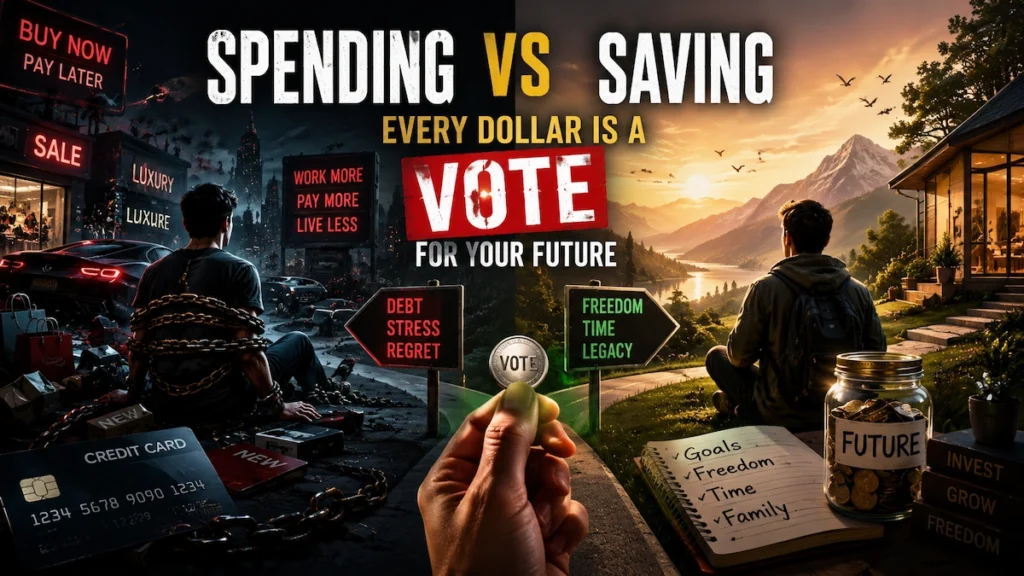
The primary difference between spending vs saving is the timing of consumption.
Spending is the immediate use of money to satisfy current needs or desires.
Saving is the act of preserving money for future goals, financial security, and long-term wealth.
Spending supports your present lifestyle.
Saving builds future freedom and financial autonomy.
You are not buying objects.
You are spending your life-force.
You are a biological clock ticking toward zero, yet you trade your limited hours on Earth for plastic and noise.
Most people are walking ghosts, trying to fill an internal abyss with a credit card.
If you must keep working a job you hate just to pay for your “prizes,” then it is not a luxury.
It is a leash.
The world wants you to spend so you remain desperate.
Spending vs saving is the difference between owning your soul and becoming a servant to your stuff.
Every time you spend just to “feel better,” you quietly confess that something inside you is empty.
You are a prisoner who has fallen in love with his cell.
Contents
Spending vs Saving: Why Your Habits Are a Silent Liturgy
You think money is paper.
It is not.
It is your life-energy, condensed into a tool.
When you work, you are selling the only thing you truly own: your finite time.
Most people are walking through a deep, unconscious sleep, trading hours of their soul for plastic trinkets and temporary hits of dopamine.
This is not “spending”; it is a slow, rhythmic suicide.
You are bleeding out your existence to decorate a cage you don’t even want to be in.
Stop looking at the price tag and start looking at the heartbeat you are sacrificing.
The Preservation of the Void: Why Saving Money Creates Freedom
The world is terrified of emptiness.
It screams at you to fill every corner of your life with noise, objects, and debt.
But the master knows that the “Void” is the only place where freedom lives.
Saving is not about the accumulation of gold; it is about the preservation of the space between you and the world’s demands.
When you have a full bank account and a lean life, you become a ghost in the system.
You cannot be bribed.
You cannot be threatened.
You have the power to sit in a room and do nothing, which makes you the most dangerous person in the room.
The Silent Election: Every Dollar Is a Vote for Your Future
Every time you open your wallet, you are participating in a secret election where the only candidate is your future self.
There are no spectators, only participants.
When you buy a luxury you cannot walk away from, you are voting for a dictator to run your life.
You are electing a version of yourself that is tired, trapped, and forced to perform.
Saving is the only revolutionary act left.
It is a vote for the version of you that can say “No” without blinking.
Stop funding your own enslavement.
Examine your “ballot” before you cast it.
A Vote for Slavery is any purchase that requires more of your future time to maintain:
high-interest debt, status symbols, vanity.
A Vote for Autonomy is any purchase that sharpens your mind or buys back your time.
A Vote for Freedom is the dollar that stays in the void.
You are not just buying a product.
You are choosing your master.
The Gilded Trap: Truth vs. Lie in Modern Consumption
| The Lie (The World’s Voice) | The Truth (The Master’s Voice) |
| “You deserve a treat after working hard.” | “You deserve freedom, not a shiny distraction.” |
| “Spending money shows your success.” | “Spending money shows your lack of self-control.” |
| “A high-status car is an investment.” | “A high-status car is a billboard for your ego.” |
| “Saving is for the boring and the fearful.” | “Saving is for the dangerous and the free.” |
| “Buying things makes life worth living.” | “Buying things makes life worth working.” |
Society is a factory designed to produce high-status hostages.
You work jobs you hate to buy things you don’t need to impress people you don’t even like.
It is a performance for an audience that isn’t even watching.
Real power is the cold, surgical ability to remain ordinary on the outside while your internal fortress becomes impregnable.
To be wealthy and look poor is a masterstroke; to be poor and look wealthy is a tragedy.
Kill the ego that demands to be seen, and you will find the freedom that the world is trying to hide from you.
If you want to understand the quiet power of those who have already mastered this invisibility, study the habits of The Millionaire Next Door.
The Middle Way: How to Balance Spending and Saving
True mastery is not about becoming a monk who fears the world; it is about being a surgeon who knows where to cut.
Do not repress your desires—that only creates psychological ghosts.
Instead, observe them.
Ask the cold question:
“Is this purchase for my joy, or is it a bandage for my insecurity?”
If it is a bandage, rip it off.
Spend only on what deepens your presence.
Save on everything that is merely a mask.
Financial discipline is not a punishment; it is the ultimate form of self-respect found in Living Below Your Means.
Use the Life-Force Formula:
Never look at a price tag in dollars.
Divide the price by your hourly after-tax earnings.
If a $300 jacket costs you 30 hours of sitting in a cubicle, you are not wearing fabric; you are wearing a week of your life that you will never get back.
If the object isn’t worth the “tick-tock” of your biological clock, leave it in the store.
Final Thought: Choose Your Future Wisely
The clock is ticking, and the election is almost over.
Every dollar in your hand is a choice: will you buy another brick for your prison, or will you buy your way out?
The world is more than happy to spend your life for you.
Disappoint the world.
Choose the silence.
Choose the void.
Choose yourself.
Are you the master of the game, or just another piece on the board?
Secure Your Autonomy:
Next: The Psychology of Silent Wealth: Stop Performing Success
Frequently Asked Questions
What is the difference between spending and saving?
Spending is using money for immediate needs, desires, or experiences. Saving is preserving money for future security, freedom, and long-term goals. Spending feeds the present moment, while saving protects your future self.
Why is saving money important for financial freedom?
Saving money creates distance between you and desperation. It gives you the ability to handle emergencies, avoid debt, and make decisions without fear. Financial freedom begins the moment you stop needing every paycheck to survive.
What are the signs of emotional spending?
Emotional spending usually happens when purchases are used to escape stress, boredom, insecurity, or emptiness. If buying something gives temporary relief but long-term regret, the purchase was likely emotional rather than intentional.
How do spending habits affect your future?
Your spending habits shape your future lifestyle, opportunities, and level of freedom. Consistent overspending creates dependency and stress, while intentional saving builds stability, autonomy, and long-term wealth.
How can I balance spending and saving wisely?
The balance between spending and saving comes from conscious decisions. Spend on things that genuinely improve your life or buy back your time, and save on anything driven by status, impulse, or external validation.