
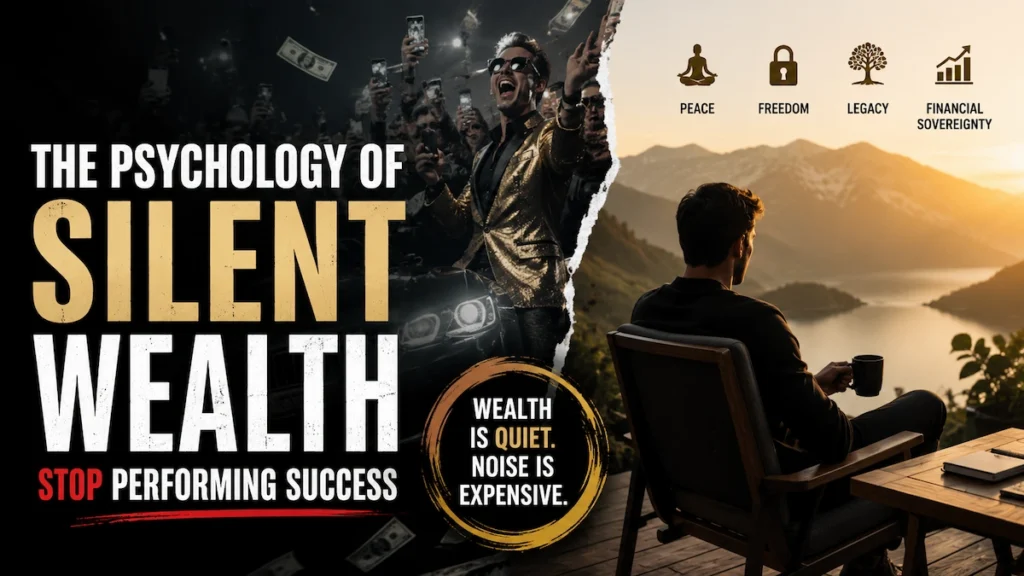
The psychology of silent wealth is the shift from external status to internal stillness.
It defines wealth not as what you show, but as the autonomy you keep.
By ending the performance of success, you build an invisible financial fortress that prioritizes sovereignty over social validation and noise.
Stop performing.
Your “success” is a costume you wear to beg for a respect you don’t even have for yourself.
You are a pauper in a golden mask, trembling at the thought of being seen as ordinary.
True wealth is silent because it has nothing to prove.
It is the stillness of a mountain that does not need the valley’s applause to exist.
If your wealth needs an audience, it isn’t power—it is a prison.
Contents
The Psychology of Silent Wealth: Why the Mountain is Power and the Valley is Noise
The world is a noisy valley filled with people screaming for attention.
Why?
Because they are vulnerable.
In any strategic environment, the loudest person is the easiest to read, the easiest to bait, and the easiest to destroy.
They broadcast their location, their ego, and their price tag 24/7.
The psychology of silent wealth is not an act of self-discovery; it is a tactical cloaking device.
It is the development of an unshakeable poker face in a world that pays for your reactions.
While the valley is obsessed with “climbing,” the mountain simply is.
True power is the ability to sit in a room and be the most influential person present because you are the only one who doesn’t need anything from anyone.
If you need a witness to your success, you’ve just handed that witness a leash.
Quiet Wealth: The Fragrance of Needing Nothing
Most “successful” people you see are just high-level beggars.
They have the car, the watch, and the house, yet they are starving for a “like” or a nod of respect from people they don’t even respect.
They are puppets.
Quiet wealth is the ultimate “Trojan Horse.”
It is the art of owning the world without letting the world own you.
When you achieve a financial freedom mindset, you aren’t just saving money; you are auditing your brain for external malware.
Every “want” that is fueled by a trend is a security breach.
To need less is to be “expensive to buy.”
It is the fragrance of a man who has taken the remote control back from society.
You are beginning to understand the discipline of the millionaire next door,
where true net worth is built in the shadows of an ordinary life, far away from the eyes of the envious.
Stop Performing Success: The Suicide of the Soul for the Sake of an Audience
You are killing your potential to build a monument for people who are too busy worrying about their own monuments to care about yours.
This performance is a tactical error.
Freedom over status is the realization that the “audience” is actually a collection of vampires draining your capital.
In the world of elite strategy, information is leverage.
When you “perform” success, you are giving away your blueprint for free.
You are showing everyone exactly where your ego is located.
Invisible wealth is the power to walk through a room as a “nobody” while holding the keys to the exit.
Stop the play.
The energy you waste on the audience is the capital you should be using to buy your sovereignty.
Invisible Wealth: The Fortress of the Void
A visible fortress is just a target.
If they can see your wealth, they can calculate your weakness.
Invisible wealth is a fortress in the Void—a mindset where reserves are hidden and your lifestyle is a strategic deception.
This is intentional living as a stealth operation.
You are witnessing a global evolution where wealthy people no longer look rich,
having realized that in an age of total surveillance, anonymity is the only luxury that cannot be hacked or stolen.
While others are busy showing off their “walls,” you are building an underground bunker of liquid assets and private power.
You don’t “hide” because you are shy; you hide because an invisible enemy is impossible to defeat.
In the void, you are not a victim of inflation, envy, or social taxes.
You are the “Unseen Master.”
This is the core strategy of the hidden wealthy; they have realized that in a world of total surveillance,
anonymity is the only luxury that can’t be bought.
Emotional Spending vs. Financial Stillness: Filling a Bottomless Pit
Every time you spend money to “feel” powerful, you have actually become weaker.
You are reacting.
And in the game of life, the one who reacts is being controlled.
Emotional spending is a sign that someone else has the remote control to your nervous system.
Financial stillness is your “Strategic Reserve.”
It is the ability to look at a status symbol and feel nothing.
No desire, no envy, no attraction.
This is not “monk-like” behavior; it is Inner Engineering for the elite.
When you master your impulses, you become unpredictable.
You cannot be baited by a sale, a trend, or a rival’s flex.
You stay still, while the world exhausts itself trying to move you.
You realize that spending vs saving isn’t a math problem—it is a power struggle.
Every dollar you keep is a vote for your future sovereignty; every dollar you waste is a vote for your own enslavement.
The Sovereign’s Execution: Global Tasks for the Unseen Master
To move from a “Performer” to a “Master,” you must perform these three Surgical Operations this week:
Task 1: The “Ghost” Audit (Financial Stillness)
The Action:
Identify one recurring expense you pay solely for “image” (a club membership you don’t use, a brand-name service, or a luxury subscription).
The Execution:
Cancel it immediately.
Do not tell anyone.
Take that exact amount and move it to a “Dark Pool” account.
The Goal:
Feel the “itch” to tell someone you are saving money—and then kill that itch.
That is the birth of Silent Power.
Task 2: The “Remote Control” Test (Emotional Wealth)
The Action:
Go to the most expensive shopping district in your city (or the most “status-heavy” website).
Spend 30 minutes looking at things you can easily afford.
The Execution:
Buy nothing.
Not even a coffee.
The Goal:
Prove to your lizard brain that you can walk through a “Golden Trap” and not get caught.
If you can stay still in a room full of bait, you own the room.
Task 3: The “Invisibility” Drill (Invisible Wealth)
The Action:
For the next 48 hours, if someone asks you “How is work?” or “How are things?”, give the most boring, average answer possible (“It’s okay,” “Just keeping busy”).
The Execution:
Hide a major win.
If you made a profit or finished a project, keep it in the “Void.”
The Goal:
To experience the high-status thrill of knowing something the world doesn’t.
Information asymmetry is the ultimate wealth.
Final Thought: The Great Silence Where Wealth Begins
Wealth doesn’t begin with a bank balance; it begins where the noise of other people’s opinions ends.
The ultimate luxury is not a brand—it is Sovereignty.
The ability to do what you want, when you want, without asking for anyone’s permission.
The ultimate evolution of power is not to be a King, but to be the Air. No one can strike the air. No one can imprison the air. No one can tax the air. Yet, without the air, the King dies on his throne.
If silent wealth is the art of needing less from the world,
Your Money or Your Life explores the deeper psychological cost behind work, consumption, and the modern pursuit of status.
It is not just a personal finance book. It is a confrontation with how people quietly trade freedom for identity.
Frequently Asked Questions
What is silent wealth?
Silent wealth is the practice of building financial security and freedom without seeking attention, status, or external validation. It focuses on inner peace, autonomy, and long-term stability instead of visible luxury.
What is the psychology of silent wealth?
The psychology of silent wealth is the shift from external status to internal stillness. It defines wealth not by what you display, but by the freedom, control, and peace you quietly maintain.
Why do wealthy people stay quiet about money?
Many financially secure people avoid displaying wealth because privacy protects freedom. Quiet wealth reduces social pressure, unnecessary comparison, and lifestyle inflation while helping people focus on long-term financial independence.
How does emotional spending destroy wealth?
Emotional spending happens when money is used to escape insecurity, stress, boredom, or the need for validation. Over time, these impulsive purchases reduce savings, increase dependency, and weaken financial freedom.
How can I stop performing success?
You can stop performing success by separating your self-worth from status symbols, social approval, and luxury spending. Focus on intentional living, financial stillness, and building a life that feels peaceful instead of impressive.