
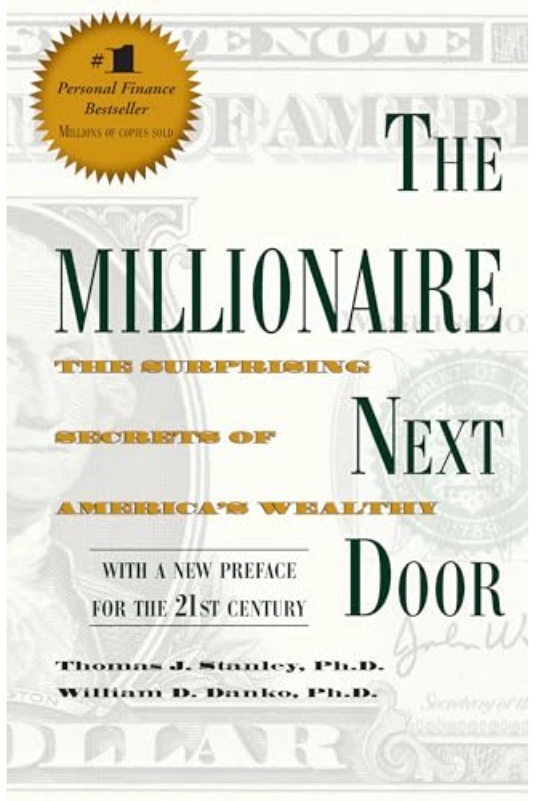
Author: Thomas J. Stanley & William D. Danko
Read Time: 6–7 Hours
Moneygatha Rating: ⭐⭐⭐⭐☆ (4/5)
The Lesson: Wealth Without Awareness Becomes A Golden Cage
The Verdict: The Millionaire Next Door is one of the rare finance books that does not try to seduce you with fantasies. It does not sell Lamborghinis, “morning routines,” or the illusion of overnight success. Instead, it quietly dismantles one of society’s biggest lies:
The Millionaire Next Door review analyzes Thomas J. Stanley’s classic study on the habits of the wealthy.
The book reveals a shocking truth:
real millionaires are rarely flashy.
They are usually:
- Self-made
- Frugal
- Patient investors
- Focused on long-term wealth instead of social status
While society teaches people to look rich, this book teaches how to become financially free.
Our summary explores how:
- Living below your means
- Avoiding lifestyle inflation
- Investing consistently
- Ignoring status pressure
can slowly build real financial independence.
But let’s stop the performance right there.
If you read this book only to learn how to save pennies on your coffee, you aren’t seeking freedom. You are seeking a more comfortable prison.
The world celebrates the “Millionaire Next Door” because he is a quiet, obedient shadow. He doesn’t disturb the peace. He doesn’t disturb the status quo.
But he also doesn’t live.
He has replaced the anxiety of being poor with the neurosis of being a miser. He isn’t wealthy. He is just a very efficient accountant for his own fear.
At Moneygatha, we don’t care how much sand you’ve collected in your jar if you’re too terrified to ever open the lid and breathe.
Ask yourself: Is it wealth if it requires you to stay small? Is it security if it makes you afraid of your own shadow?
Frugality without awareness is not a strategy. It’s just “Rich Poverty.”
Contents
The Millionaire Next Door Review: A Manual for the Disciplined Grave
Most people search for a review of The Millionaire Next Door because they are looking for safety.
A respectable blueprint.
A data-driven excuse to avoid uncertainty.
A comforting promise that disciplined mediocrity will eventually lead to freedom.
The formula sounds simple:
Save aggressively.
Spend carefully.
Live below your means.
Wait patiently for decades.
And yes… the math works.
But at Moneygatha, we are not interested in financial formulas alone.
We are interested in the psychology hiding beneath them.
Because every financial philosophy secretly shapes the human spirit behind it.
And this book carries a hidden danger.
While it is celebrated as one of the greatest personal finance books ever written, it can also become a blueprint for a beautifully disciplined prison.
A Golden Cage.
The cage looks responsible from the outside.
No debt.
No financial chaos.
No reckless consumption.
But silently, something else begins to disappear:
Spontaneity.
Risk.
Adventure.
Aliveness.
The danger is not in the investing principles.
Those are timeless.
The danger is in what happens when discipline loses awareness.
When saving money becomes emotionally safer than living life.
When security becomes more important than freedom.
When the fear of losing money becomes stronger than the desire to truly live.
That is the hidden shadow inside this book.
It teaches people how to accumulate wealth brilliantly.
But many readers unconsciously learn something else:
How to postpone life indefinitely.
This is not just a review.
It is a psychological autopsy of modern financial culture.
Because if you follow this philosophy blindly, you may succeed financially while quietly becoming a prisoner of your own caution.
And there is nothing more tragic than building a massive net worth…
while your inner world slowly dies from underuse.
The Book That Quietly Kills Modern Illusions
This is not just a finance book.
It is an autopsy of the modern success fantasy.
It pulls back the velvet curtain of upper-middle-class life and exposes something deeply unsettling:
Many people who appear successful are financially fragile.
Their lifestyle is not freedom.
It is maintenance.
A carefully managed performance funded by debt, social pressure, and the fear of appearing ordinary.
This philosophy feels psychologically explosive because it destroys one of society’s oldest illusions:
“If you look successful, you are successful.”
The reality is often the opposite.
Real wealth usually looks painfully average.
It may look like:
- a small business owner
- a neighbor driving an old car
- a couple living quietly below their means
- someone society completely overlooks
And once this illusion breaks, the entire economic machine starts looking different.
Luxury brands stop feeling aspirational.
Status symbols start feeling insecure.
Social comparison starts feeling absurd.
You begin to realize that most consumption is not self-expression.
It is emotional compensation.
People are not buying products.
They are buying reassurance.
Reassurance that they matter.
Reassurance that they belong.
Reassurance that they are “winning.”
This framework burns that illusion to the ground.
But then it introduces an even more uncomfortable truth:
Nobody is coming to save you.
Not corporations.
Not governments.
Not the financial system.
Your future depends largely on your ability to think independently, resist social hypnosis, and delay gratification in a world addicted to instant pleasure.
That level of self-responsibility terrifies most people.
Because it destroys the comforting fantasy that the system is designed to protect them.
But hidden inside this philosophy is a razor’s edge.
In destroying the illusion of consumerism, it can accidentally create another illusion:
That life itself is just a financial optimization problem.
That every experience must justify its cost.
That every pleasure must be efficient.
That safety is the highest form of intelligence.
And this is where awareness becomes essential.
Because a life ruled entirely by calculation may become financially stable…
but emotionally sterile.
The fake architecture of status culture gets demolished beautifully.
But once the smoke clears, you are left standing in the ashes holding a calculator.
Whether that calculator becomes:
- a bridge to freedom
or - a wall built from fear
depends entirely on your consciousness.
The Great Illusion: Truth vs. Society’s Lie
Modern society trains people to confuse visibility with value.
The louder something looks, the more important it appears.
A luxury watch looks successful.
A massive house looks powerful.
A premium lifestyle looks aspirational.
But appearance and reality are rarely the same thing.
Most people are not building wealth.
They are renting symbols of it.
And the system encourages this behavior because insecure people are easier to control.
A person constantly trying to “keep up” never feels free.
They remain trapped inside comparison.
Always chasing.
Always upgrading.
Always proving.
This philosophy destroys that entire game.
| Society’s Lie | The Deeper Reality |
|---|---|
| Wealth must look impressive | Real wealth is usually invisible |
| High income means financial freedom | Low dependency creates freedom |
| Luxury creates status | Ownership creates peace |
| Expensive lifestyles equal success | Most luxury is social performance |
| More consumption means a better life | More awareness means a better life |
| Looking rich matters | Being free matters |
This truth feels liberating at first.
Until it starts becoming dangerous.
Because escaping one illusion does not guarantee freedom.
Sometimes people simply exchange one prison for another.
The Psychological Cage: Why Frugality Without Awareness Is Fear
Discipline is powerful.
But unconscious discipline becomes self-punishment.
At first, financial restraint feels intelligent.
You stop wasting money.
You stop buying validation.
You stop performing wealth for strangers.
Beautiful.
But slowly, something subtle begins happening inside the mind.
Every expense starts creating anxiety.
Every desire feels irresponsible.
Every risk feels dangerous.
The person no longer controls money.
Money controls the nervous system.
This is the hidden psychological trap.
Frugality can quietly become fear wearing the mask of wisdom.
And because society praises financial caution, this fear often goes unnoticed for decades.
People call it:
- maturity
- responsibility
- practicality
But deep inside, many are simply terrified of uncertainty.
The obsession with security becomes endless.
First they want:
- an emergency fund
- then more savings
- then a bigger portfolio
- then “just a little more safety”
But fear has no finish line.
The numbers grow.
The anxiety adapts.
That is why some financially successful people still live emotionally tense lives.
Because external wealth cannot solve internal insecurity.
Net Worth vs. Aliveness: The High Cost of Deferred Living
Modern financial culture worships delayed living.
Work now.
Enjoy later.
Sacrifice now.
Relax later.
Survive now.
Live later.
But “later” is one of the mind’s greatest deceptions.
Life is happening now.
Your youth is happening now.
Your relationships are happening now.
Your energy is happening now.
And many people unknowingly spend the healthiest years of their lives preparing for a future version of happiness that never emotionally arrives.
Everything becomes optimization.
Experiences become calculations.
Joy becomes inefficient.
Spontaneity becomes “financially irresponsible.”
Slowly, the person stops living organically.
They become a machine for future security.
This is the paradox nobody discusses:
A person can become financially rich while psychologically starving.
Their investments compound beautifully.
Their inner world slowly dries out.
The tragedy is not poverty alone.
The deeper tragedy is reaching the end of life with:
- financial stability
but - emotional emptiness
Because money was meant to support life.
Not replace it.
Financial Independence vs. Emotional Starvation
There is a massive difference between simplicity and scarcity.
They may look similar externally.
But internally, they are worlds apart.
Intentional Simplicity
Intentional simplicity comes from awareness.
You spend carefully because you understand the emptiness of status games.
You stop consuming unconsciously.
You prioritize freedom over appearance.
You own your possessions instead of letting them own you.
There is peace in this.
Unconscious Scarcity
Scarcity is different.
Scarcity comes from fear.
Fear of loss.
Fear of instability.
Fear of not being enough.
These people cannot enjoy wealth even after creating it.
The mind keeps whispering:
“What if everything disappears?”
So they continue optimizing endlessly.
More control.
More calculation.
More restraint.
Their financial life becomes efficient.
Their emotional life becomes fragile.
This is not freedom.
This is survival disguised as intelligence.
True financial independence is not just having enough money.
It is having enough inner freedom to actually experience life without constant psychological tension.
The Sovereign Blueprint: Strategic Intelligence
To master the mechanics of a sovereign life, you must look beyond the pages of a single book.
The following modules form a complete strategic architecture designed to move you from a visible target to an unseen master.
Final Verdict: Use the Philosophy as a Mirror, Not a Religion
This philosophy remains one of the most important frameworks in personal finance.
It destroys dangerous illusions:
- status obsession
- lifestyle inflation
- performative wealth
- unconscious consumption
It teaches patience.
Discipline.
Long-term thinking.
Financial independence.
These lessons are timeless.
But every philosophy becomes dangerous when followed blindly.
And this framework becomes dangerous when people transform financial caution into a permanent identity.
Because the goal of money is not endless accumulation.
The goal is freedom.
Freedom from comparison.
Freedom from social pressure.
Freedom from financial panic.
Freedom from living for appearances.
Build wealth.
Invest wisely.
Avoid consumer hypnosis.
But do not become emotionally absent from your own existence in the process.
Because the saddest possible outcome is not dying broke.
It is dying financially secure…
while realizing you never truly allowed yourself to live.
Frequently Asked Questions
Is The Millionaire Next Door still worth reading today?
Yes. The philosophy of living below your means, avoiding lifestyle inflation, and investing consistently is still highly relevant today. While the economy and technology have changed, the psychology of money has not. Most people still confuse looking rich with being financially secure.
What is the main message of The Millionaire Next Door?
The core message is simple: Real wealth is usually built quietly through discipline, frugality, investing, and long-term thinking — not through flashy spending or social status. The book argues that financial independence matters more than appearing successful.
Why do some people criticize The Millionaire Next Door?
Some readers criticize the philosophy because extreme frugality can sometimes create fear-based living. When followed without awareness, financial discipline can slowly turn into guilt around spending, emotional scarcity, and the habit of endlessly postponing life for future security.
Is The Millionaire Next Door a good book for beginners?
Yes. It is considered one of the best beginner-friendly personal finance books because it explains wealth-building habits in a simple and practical way. It helps readers understand investing, financial independence, budgeting, and the long-term impact of lifestyle inflation.
What does The Millionaire Next Door teach about wealthy people?
The book reveals that many wealthy people live surprisingly ordinary lives. Instead of trying to appear rich, they often focus on saving consistently, owning assets, avoiding unnecessary debt, and building long-term financial stability quietly.
What is the biggest lesson from The Millionaire Next Door?
The biggest lesson is that financial freedom usually comes from controlling desires rather than increasing appearances. The book teaches that lasting wealth is built through patience, awareness, and independence from social pressure instead of chasing status symbols or luxury lifestyles.
Loved this review? Explore the full Moneygatha book library to master your mindset, strategy, and discipline.